What Is a Turntable Stylus? Stylus vs. Cartridge Explained
Introduction
If you’re new to vinyl, few turntable parts are more confusing than the tiny component at the end of the tonearm.
You may hear it called a needle or a stylus. Then you start looking for a replacement and suddenly you’re dealing with cartridges, headshells, cantilevers, stylus shapes, moving magnets, tracking force, and a vocabulary that can make a simple turntable feel far more complicated than it needs to be.
The good news is that the basic idea is surprisingly simple.
The stylus is the small tip that physically traces the record groove. As it follows the microscopic contours cut into the groove, its movement travels through the cantilever to the cartridge. The cartridge converts that mechanical movement into an electrical audio signal, which is then processed and amplified before reaching your speakers.
Understanding this relationship helps you do more than learn turntable terminology. It can help you take better care of your records, recognize common playback problems, understand when a stylus may need to be replaced, and make smarter decisions about upgrades without spending money on components you don’t actually need.
In this guide, we’ll break down how a turntable stylus works, how it differs from a cartridge, why stylus shape matters, when replacement makes sense, and what to look for when choosing a replacement. No audiophile vocabulary required.
1. What Is a Turntable Stylus?
A turntable stylus is the small component at the end of the tonearm that makes physical contact with a vinyl record.
You may also hear it called a needle, although “stylus” is the more precise term used in turntable and cartridge specifications.
At the very end of the stylus assembly is an extremely small tip, typically made from diamond. As the platter rotates, that tip traces the contours of the record groove.
But it doesn't simply “read” the groove in the way a laser reads a disc.
It physically moves.
The Groove Is a Physical Recording of Sound
A vinyl record may look smooth from across the room, but its surface contains a continuous spiral groove with microscopic variations.
Those variations represent the recorded audio.
As the record spins, the stylus traces those variations. The shape of the groove causes the stylus to move in precisely controlled ways, including side-to-side and vertical movement, depending on the groove geometry and cartridge design.
Those movements are mechanical information.
They must then be converted into an electrical audio signal before the rest of the system can amplify and reproduce them through your speakers.
That's where the cartridge comes in.
From Record Groove to Audio Signal
A simplified vinyl playback chain looks like this:
Record groove → stylus → cantilever → cartridge → phono preamp → amplifier → speakers
In a system using powered speakers, the amplifier may already be built into the speakers. A turntable may also have a built-in phono preamp, which means some of the electronics in this chain are integrated into the turntable itself.
But the fundamental process remains the same.
The stylus has to trace the groove accurately enough for the cartridge to convert those physical movements into an electrical signal.
That's one reason such a tiny component can have a surprisingly noticeable influence on vinyl playback—and why proper stylus care, alignment, and replacement matter over time.
2. Stylus vs. Needle vs. Cartridge: What's the Difference?

This is where many beginners get confused.
The terms are closely related, but they don't describe exactly the same thing.
Stylus and Needle Usually Mean the Same Thing
In everyday conversation, stylus and needle generally refer to the same part of a turntable.
“Needle” is the traditional consumer term. “Stylus” is the term you'll see more often in technical descriptions, cartridge specifications, and replacement-part listings.
So if someone says:
“I think my turntable needle needs replacing.”
They're usually talking about the stylus.
The Cartridge Is the Larger Component
Look closely at the end of a typical tonearm.
You'll usually see a small housing mounted beneath the headshell or attached to the end of the tonearm. That housing is the phono cartridge.
The stylus assembly attaches to the cartridge and, on many common cartridge designs, can be removed and replaced separately. On other designs, the stylus is not intended to be replaced independently.
A useful mental model is:
Stylus = the part that traces the record groove
Cartridge = the component that converts that movement into an electrical signal
The cartridge contains the components responsible for generating the audio signal. Depending on its design, those components may use magnets and coils arranged in different ways.
What About the Cantilever?
The diamond tip isn't normally connected directly to the cartridge body.
Instead, it sits at the end of a tiny rod called the cantilever.
As the stylus traces the groove, the cantilever transfers those movements into the cartridge's generator.
So when people casually say “stylus,” they may be referring specifically to the stylus tip or, in the context of replacement parts, to a larger stylus assembly that includes the tip and cantilever.
And What Is a Headshell?
On many turntables, the cartridge mounts to a component called the headshell, which sits at the front of the tonearm.
Some headshells are removable. Others are integrated into the tonearm.
This creates a useful mental model:
Tonearm → headshell → cartridge → stylus assembly → record groove
Not every turntable uses exactly the same construction, but understanding these terms makes replacement parts, setup instructions, and compatibility much easier to navigate.
Quick Comparison
| Part | What It Does | Normally Replaceable? |
|---|---|---|
| Stylus | Traces the record groove | Often, depending on the cartridge |
| Cantilever | Transfers stylus movement to the cartridge generator | Usually part of the stylus assembly |
| Cartridge | Converts mechanical movement into an electrical signal | Often, depending on the turntable |
| Headshell | Holds the cartridge on many tonearms | Depends on the turntable |
| Tonearm | Guides the cartridge and stylus across the record | Not a routine replacement item |
The important lesson is that replacing a stylus and replacing a cartridge are not necessarily the same job.
For many turntables, a worn stylus can be replaced without replacing the entire cartridge. But compatibility matters: always check the cartridge model, stylus design, and turntable manufacturer's specifications before ordering a replacement.
3. How Does a Turntable Stylus Actually Produce Music?

Vinyl playback is fundamentally mechanical.
That's part of what makes it fascinating.
There isn't a digital file stored inside the record. Instead, the recorded audio is represented by physical variations in the record groove, and the stylus traces those variations to begin the playback process.
Here's how it works.
Step 1: The Record Rotates
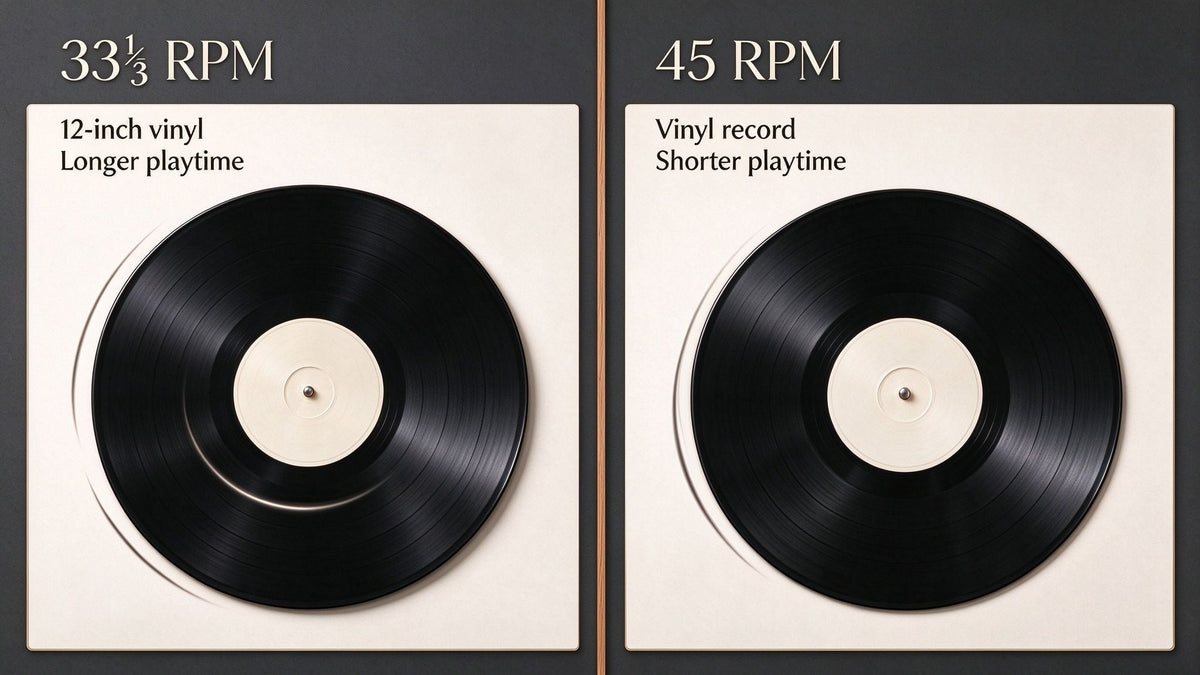
Most 12-inch LPs rotate at 33⅓ RPM, while many singles and some smaller records play at 45 RPM.
As the platter rotates, the spiral groove moves underneath the stylus.
The groove itself contains tiny physical variations that correspond to the recorded audio.
Step 2: The Stylus Follows the Groove
The stylus tip sits inside the record groove.
As the groove changes shape, the stylus moves with it.
Those movements are extraordinarily small, but they contain the information needed to reproduce the recording, including vocals, instruments, dynamics, and stereo information.
The stylus doesn't “read” the record by looking at it. It physically traces the groove, turning the groove's microscopic variations into mechanical movement.
Step 3: The Cantilever Transfers the Movement
The stylus tip moves the cantilever.
Think of the cantilever as a tiny mechanical bridge between the record groove and the cartridge's internal generator.
As the stylus traces the groove, the cantilever transfers those tiny movements into the cartridge. The cartridge's generator then responds to that movement and produces an electrical signal.
The cantilever needs to respond accurately to extremely small and rapid movements because the groove contains information across a wide range of frequencies.
Step 4: The Cartridge Creates an Electrical Signal
The cartridge converts the stylus and cantilever's mechanical movement into a very small electrical audio signal.
That signal is much weaker than the line-level signal produced by sources such as a CD player or streaming device.
That's why a traditional turntable system needs a phono preamp, also called a phono stage.
The phono stage raises the cartridge's low-level signal to a usable level and applies the standardized RIAA equalization needed for proper playback.
Depending on the setup, the phono preamp may be built into the turntable, amplifier, or powered speakers—or it may be a separate component.
If you've ever wondered why you can't always connect a turntable directly to any pair of speakers, this is a big part of the answer.
Step 5: Your System Turns the Signal Back Into Sound
From the phono stage, the signal travels through the rest of the audio system.
It may go to an amplifier and then to passive speakers, or directly to powered speakers that have amplification built in.
The speakers then convert the electrical signal back into physical movement, moving air to create the sound you hear.
So vinyl playback completes a remarkable circle:
Physical groove → mechanical movement → electrical signal → speaker movement → sound
That's analog playback in its simplest form.
And it all starts with a tiny stylus following a groove that's small enough to be almost impossible to see with the naked eye.
4. Why Stylus Shape Matters

Not all styli have the same tip geometry.
You may encounter terms such as:
-
Conical
-
Spherical
-
Elliptical
-
Nude elliptical
-
MicroLine
-
Fine line
-
Shibata
For a beginner, those names can make cartridge and stylus shopping feel more complicated than it needs to be.
You don't need to memorize every stylus profile to understand the basic principle:
Different stylus shapes make contact with the record groove in different ways.
That affects how accurately the stylus can trace the groove, how much detail it can retrieve, and how sensitive it may be to setup and alignment.
Conical Stylus
A conical stylus—sometimes also described as spherical—is one of the simplest and most common stylus profiles.
Its rounded shape makes it relatively forgiving and economical.
Advantages
Conical styli tend to be affordable, straightforward, and relatively forgiving of minor setup differences.
That makes them practical for entry-level turntables, casual listening, and listeners who want a simple, low-maintenance setup.
Limitations
Because of their shape, conical styli generally don't trace the smallest groove variations as precisely as more advanced profiles.
The difference can become more noticeable toward the inner portion of a record, where the groove moves through a smaller radius and tracing becomes more demanding.
Elliptical Stylus
An elliptical stylus has a narrower tracing profile than a basic conical design.
That allows it to follow certain groove modulations more accurately and can improve the retrieval of finer musical information.
For many home listeners, an elliptical stylus offers an excellent middle ground between price, performance, and setup requirements.
You may hear improved clarity, cleaner high frequencies, and more detail compared with a basic conical stylus—assuming the rest of the system is capable of revealing those differences.
Advanced Line-Contact Designs
More sophisticated stylus profiles are designed to trace the groove with a narrower tracing radius and a different contact pattern along the groove walls.
Examples include MicroLine, Shibata, and other fine-line or line-contact designs.
Depending on the cartridge and overall setup, these profiles can offer benefits such as:
-
Greater retrieval of high-frequency detail
-
Improved tracking
-
Reduced inner-groove distortion
-
More accurate tracing of complex groove information
But there is a tradeoff.
Advanced stylus profiles generally benefit more from careful cartridge alignment and correct turntable setup.
A premium stylus that is poorly aligned isn't automatically going to perform better than a simpler stylus that is correctly installed and tracking at the manufacturer's recommended force.
Does a Better Stylus Always Sound Better?
Not automatically.
Your turntable is a system.
Stylus geometry matters, but so do:
-
Cartridge compatibility
-
Cartridge alignment
-
Tracking force
-
Tonearm compatibility
-
Record condition
-
Phono stage
-
Amplification and speakers
-
Turntable setup and isolation
For a beginner, the goal shouldn't be to buy the most exotic stylus possible.
It should be to choose a good stylus that is compatible with the cartridge and turntable, then make sure it is correctly installed and set up.
In other words, the best stylus isn't necessarily the most expensive one. It's the one that works well with the rest of your system and is set up correctly.
5. Moving Magnet vs. Moving Coil Cartridges

Once you understand the difference between a stylus and a cartridge, you'll eventually encounter another pair of terms:
MM and MC.
These stand for moving magnet and moving coil.
Both are cartridge designs that convert the stylus and cantilever's mechanical movement into an electrical audio signal. The main difference is which part of the cartridge's generator moves.
Moving Magnet (MM)
Moving magnet cartridges are extremely common in home turntables, especially entry-level and midrange systems.
In simplified terms, movement from the stylus and cantilever causes a small magnet to move relative to fixed coils inside the cartridge.
That movement generates the electrical audio signal.
MM cartridges offer several practical advantages:
-
Widely available
-
Relatively affordable
-
Typically higher output than many MC designs
-
Compatible with many phono stages
-
Replacement styli are available for many models
-
Straightforward to use for everyday vinyl listening
For someone building a first vinyl system, MM is usually the simpler category to understand, maintain, and upgrade.
One particularly useful advantage is that many MM cartridges allow you to replace the stylus without replacing the entire cartridge.
Moving Coil (MC)
Moving coil cartridges use a different generator arrangement: tiny coils move within a magnetic field.
MC cartridges are commonly associated with more advanced hi-fi systems.
They can offer excellent performance, but they often have lower output levels, may require a phono stage with the appropriate gain and loading, cost considerably more, and frequently don't offer a simple user-replaceable stylus.
With many MC cartridges, replacing a worn stylus means replacing or rebuilding the cartridge itself rather than simply installing a new stylus assembly.
That doesn't make MC automatically “better” for every listener.
It makes it a different design with different system requirements.
MM vs. MC: Which Is Better for Beginners?
For most first-time vinyl listeners, a quality moving magnet cartridge is the more practical choice.
It keeps the system relatively simple while leaving plenty of room for excellent sound.
You don't need an exotic cartridge design to enjoy records.
A properly installed, well-matched MM cartridge can provide years of satisfying listening, and the availability of replacement styli can make long-term maintenance easier.
If you eventually want to explore higher-end cartridge designs, MC can be an option—but it's usually worth making sure the rest of your turntable and phono system is ready for it first.
The important thing is not to choose based on the letters MM or MC alone.
Choose the cartridge that is compatible with your tonearm and phono stage, appropriate for your setup, and practical for the way you actually listen to vinyl.
6. When Should You Replace Your Turntable Stylus?
A stylus is a wear item.
Even though the tip is typically made from diamond—an extremely hard material—it spends its life traveling through vinyl grooves under a carefully controlled tracking force.
Eventually, it wears.
The challenge is that stylus wear isn't always obvious.
Don't Rely on a Single Universal Hour Number
You'll often see stylus life expressed as a certain number of playback hours.
That can be useful as a rough planning tool, but there is no single number that applies perfectly to every stylus.
Lifespan can depend on factors including:
-
Stylus design and profile
-
Manufacturer recommendations
-
Cartridge alignment
-
Record cleanliness
-
Stylus cleanliness
-
Record condition
-
Listening frequency
The best starting point is always the replacement or service-life guidance provided by your cartridge or stylus manufacturer.
If you're unsure, it's better to treat a manufacturer's recommendation as a guideline rather than trying to stretch a stylus indefinitely.
Signs Your Stylus May Need Attention
Possible warning signs include:
Increasing distortion
Music that once sounded clean begins to sound rough or distorted, especially during loud or complex passages.
Sibilance
“S” sounds in vocals become unusually sharp, splashy, or distorted.
Poor tracking
The stylus struggles to stay stable in passages that previously played normally, or you notice repeated mistracking or skipping.
Unexpected channel imbalance
One channel may sound noticeably different from the other.
Keep in mind that channel imbalance can have causes other than stylus wear, including cartridge alignment, connections, or other parts of the audio system.
Visible damage
A bent cantilever, visibly damaged stylus tip, or loose stylus assembly is a strong reason to stop playback until the problem can be properly assessed.
A sudden change after an accident
If the tonearm was dropped, dragged across a record, bumped hard, or the stylus was accidentally contacted during cleaning or handling, inspect the stylus before continuing to play records.
Why You Shouldn't Keep Playing With a Damaged Stylus
Records are replaceable in theory.
In practice, some aren't.
A favorite pressing may be expensive, sentimental, rare, or simply difficult to find again.
If a stylus appears damaged or suddenly begins mistracking badly, continuing to play records isn't worth the risk.
Stop playback and inspect the problem first.
If you're not sure whether the stylus is damaged, consult the cartridge or turntable manufacturer, or have the setup inspected by a qualified technician.
Keep a Simple Listening Log
You don't need to track every side of every record in a spreadsheet.
But if you listen frequently, noting approximately when a stylus was installed can be helpful.
For example:
Stylus installed: October 2026
If you know you listen for roughly five hours each week, you can estimate your approximate usage over time and compare it with the manufacturer's service-life guidance.
That's much better than realizing several years later that you have no idea how old the stylus is.
A simple note in your phone is enough.
7. Should You Replace the Stylus or the Entire Cartridge?
This is one of the most useful distinctions a vinyl beginner can learn.
If your stylus wears out, you may not need a new cartridge.
In many cases, replacing only the stylus is the simpler and more affordable solution.
Replace Only the Stylus When…
A stylus-only replacement often makes sense when:
-
The cartridge body is working properly
-
A compatible replacement stylus is available
-
You're happy with the cartridge's sound
-
You want the simplest maintenance option
-
The existing cartridge and tonearm setup is already correct
On many moving magnet cartridges, the stylus assembly is designed to be removed from the cartridge body and replaced separately.
Depending on the cartridge design, the replacement stylus may slide, clip, or otherwise attach to the cartridge body.
Replacing only the stylus can therefore be relatively straightforward.
After installation, however, it's still worth checking the manufacturer's recommended tracking force and confirming that the stylus is seated correctly.
Replace the Cartridge When…
A complete cartridge replacement may make more sense when:
-
The cartridge itself is damaged
-
A compatible replacement stylus is no longer available
-
You want to change the cartridge's sonic characteristics
-
You're making a larger system upgrade
-
Your existing cartridge has limited replacement or upgrade options
-
The cartridge isn't a good match for your current tonearm or phono stage
Changing the entire cartridge usually creates additional setup work because the new cartridge has to be positioned and adjusted correctly.
Depending on the turntable and tonearm, you may need to check:
-
Overhang
-
Tracking force
-
Anti-skate
-
Cartridge wiring
-
Compatibility with the phono stage
That's why a stylus-only replacement can be such an attractive option for newer vinyl listeners.
If the cartridge itself is still healthy and you're satisfied with its performance, there may be little reason to replace the entire assembly simply because the stylus has worn out.
A Common Beginner Mistake
One of the most common mistakes is searching for “a new cartridge” when the actual need is a replacement stylus.
This confusion is easy to make because beginners often use terms like “needle,” “stylus,” and “cartridge” interchangeably.
Before ordering anything, identify the exact cartridge model installed on your turntable.
Then check the manufacturer's compatibility information for the correct replacement stylus.
Don't buy based on appearance alone.
Two stylus assemblies can look similar while being mechanically incompatible or intended for different cartridge models.
When in doubt, match the exact cartridge model and manufacturer specifications before ordering.
8. How Much Does the Stylus Affect Sound Quality?
Quite a bit—but context matters.
The stylus is the first part of the playback chain that physically traces the information encoded in the record groove.
If the stylus cannot accurately follow those groove variations, the cartridge can only convert the movement it receives. Later components can't fully recover information that wasn't accurately traced in the first place.
What You Might Hear From a Stylus Upgrade
Depending on the original stylus, cartridge, records, and overall system, an upgrade may improve:
-
High-frequency clarity
-
Vocal definition
-
Instrument separation
-
Tracking during difficult passages
-
Inner-groove performance
-
Retrieval of fine musical detail
-
Overall sense of openness
The size of the improvement, however, depends heavily on what you're upgrading from.
A worn or basic stylus may leave considerably more room for improvement than an already well-matched, properly aligned stylus.
And expectations should remain realistic.
Replacing a $30 stylus with a more sophisticated one won't magically turn inexpensive desktop speakers into a reference listening system.
Think About the Whole System
Imagine two setups.
Setup A
An excellent cartridge and advanced stylus, but the turntable sits on a wobbly cabinet directly beside a speaker.
Setup B
A modest but competent cartridge, correctly aligned, with clean records, proper tracking force, stable furniture, and sensible speaker placement.
Setup B may easily provide the more enjoyable listening experience.
That's because vinyl playback is a system, not a collection of isolated components.
Vinyl playback rewards system balance.
That's especially important for beginners, because upgrades can become an expensive distraction from basic setup problems.
Before spending more on a stylus or cartridge, make sure the fundamentals are right: the stylus is clean and in good condition, the cartridge is compatible and properly aligned, tracking force is set correctly, records are clean, and the turntable has a stable surface.
Sometimes the best upgrade isn't a more expensive component.
It's simply getting the setup you already own working the way it should.
9. How to Care for a Turntable Stylus

Stylus care doesn't need to become a ritual.
A few good habits go a long way toward keeping your stylus performing properly and protecting your records.
Keep Your Records Clean
Dust and debris in a record groove can come into contact with the stylus during playback.
Keeping your records reasonably clean helps reduce the amount of debris the stylus encounters and can improve playback quality.
A carbon-fiber record brush can be useful for removing loose surface dust before listening.
Heavily contaminated records may require a more thorough cleaning method.
Clean the Stylus Carefully
Stylus cleaning is one area where aggressive technique can cause more harm than neglect.
Use a cleaning method recommended by the cartridge or stylus manufacturer.
If you're using a stylus brush, follow the manufacturer's instructions for the proper direction of brushing. Avoid applying sideways pressure to the cantilever or stylus assembly.
The cantilever is delicate, and very little force is needed.
When in doubt, gentle is better.
Lower the Tonearm Gently
Use the cueing lever when available.
Dropping the stylus onto the record by hand increases the chance of an accidental impact or an imprecise landing.
A cueing mechanism lowers the tonearm gradually and predictably, making it easier to place the stylus safely into the groove.
Don't Drag the Stylus Across the Record
Everyone makes mistakes.
You reach toward the tonearm, your hand slips, and the stylus skates across the record with a noise that makes every vinyl collector wince.
An occasional accident doesn't necessarily mean the stylus is damaged, but repeated rough handling can shorten its useful life and increase the risk of damage.
If a severe impact occurs, inspect the stylus and cantilever before playing valuable records.
If anything looks bent, loose, or otherwise unusual, it's better to stop and have the setup checked rather than risk damaging the record.
Use the Correct Tracking Force
Tracking force is the downward force applied by the stylus to the record groove.
It needs to be set within the range recommended for your specific cartridge or stylus.
Too little isn't automatically safer.
If the tracking force is significantly below the manufacturer's recommendation, the stylus may track poorly and move unpredictably within the groove.
Too much force is also undesirable and can place unnecessary pressure on the stylus and record.
If your turntable has adjustable tracking force, follow the cartridge manufacturer's recommended range and your turntable's setup instructions carefully.
The goal isn't simply to use the lightest possible tracking force.
It's to use the correct tracking force for the stylus and cartridge you're using.
Keep the Turntable Level and Stable
A turntable works best on a solid, level surface.
Avoid unstable furniture and locations where footfalls or movement can cause the stylus to jump.
Speaker vibration can also reach the turntable mechanically. This is one reason it's often helpful to keep the turntable on a stable surface and avoid placing it directly on lightweight furniture that is easily affected by speaker vibration.
Good placement doesn't just improve playback.
It also helps the stylus maintain stable contact with the groove, which is an important part of getting consistent performance from your vinyl setup.
10. How to Choose a Replacement Stylus

Replacing a stylus isn't like buying a universal USB cable.
Compatibility matters.
The right replacement needs to fit your cartridge and work properly with your turntable's setup. Buying based on appearance, price, or a vague product description can easily lead to the wrong stylus.
Here's a simple way to narrow down the right one.
Step 1: Identify Your Cartridge
Start by finding the exact cartridge model installed on your turntable.
The model number may be printed on the cartridge itself or listed in your turntable's manual or product specifications.
Don't assume that every example of the same turntable model still has the original cartridge, especially if you bought the turntable used.
A previous owner may have replaced it.
This is why identifying the actual cartridge currently installed is more reliable than searching for a stylus based only on the turntable model.
Step 2: Check Manufacturer Compatibility
Once you know the cartridge model, look for replacement styli specifically designed for that cartridge.
Some cartridge families support multiple compatible stylus options.
That can create a useful upgrade path.
Instead of removing and realigning the entire cartridge, you may be able to install a more advanced compatible stylus while keeping the existing cartridge body.
However, don't assume that every stylus from the same brand or product family will fit.
Check the manufacturer's compatibility information before buying.
Step 3: Decide Whether You're Replacing or Upgrading
These are two different goals.
If you liked how your system sounded before the stylus wore out, an equivalent replacement may be all you need.
If you're looking for improved detail, tracking, or a different level of performance, investigate compatible upgrade styli.
An upgrade can be a convenient way to improve an existing cartridge without replacing the entire cartridge assembly.
But don't assume the most expensive option is automatically the best choice.
The stylus still needs to be compatible with your cartridge, appropriate for your turntable, and suitable for the rest of your system.
Step 4: Buy From a Trustworthy Source
The stylus is one component where authenticity, condition, and compatibility matter.
A suspiciously cheap replacement isn't necessarily a bargain if the stylus quality, construction, or fit isn't what your cartridge is designed to use.
Whenever possible, choose the manufacturer's specified replacement or a reputable alternative with clearly documented compatibility.
Be especially cautious with listings that use vague descriptions such as “fits most turntables” or don't clearly identify the compatible cartridge models.
A stylus that looks right isn't necessarily the right stylus.
Step 5: Recheck Setup After Installation
A stylus-only replacement within the same cartridge family often avoids the need to remove and realign the entire cartridge.
Even so, it's worth checking the basics after installation.
Make sure:
-
The stylus assembly is fully seated
-
The cantilever appears straight
-
Tracking force is appropriate for the replacement stylus
-
The turntable is level and stable
-
Playback sounds normal
If you've installed an entirely new cartridge, alignment becomes much more important because the cartridge's position and angle may need to be adjusted for proper tracking.
When in Doubt, Check the Exact Model
If you're unsure which stylus to buy, don't guess based on photographs or general descriptions.
Confirm the cartridge manufacturer and exact model number, then check the manufacturer's replacement-stylus information.
If the cartridge has been changed from the turntable's original specification, use the cartridge model—not the turntable model—as your starting point.
A few minutes of checking before you order can save you from buying an incompatible stylus and, more importantly, help protect your records and your turntable setup.
11. Common Stylus Mistakes Beginners Should Avoid
The stylus is tiny and delicate, but caring for it doesn't require anxiety.
Most problems come from a handful of avoidable mistakes.
Once you know what to watch for, stylus care becomes a simple part of normal vinyl listening.
Mistake 1: Touching the Stylus With Your Finger
Avoid touching the stylus tip or cantilever with your fingers.
Skin oils and debris aren't helpful around such a small, sensitive component, and an accidental sideways push can damage the cantilever.
If you're handling a replaceable stylus assembly, hold it by the housing rather than touching the stylus or cantilever itself.
Mistake 2: Assuming Every Stylus Fits Every Cartridge
They don't.
Two styli may look nearly identical and still be incompatible with different cartridge models.
Always verify the exact cartridge model and the manufacturer's compatible stylus options before buying a replacement.
Don't rely on appearance alone.
Mistake 3: Buying an Upgrade Before Fixing Setup Problems
If your records suddenly sound distorted, don't immediately assume you need a better stylus.
First check the basics:
-
Record cleanliness
-
Stylus cleanliness
-
Tracking force
-
Cartridge alignment
-
Turntable level and stability
-
Speaker placement
-
Whether the record itself is damaged
A poorly adjusted turntable can make a good stylus perform badly.
Fix the setup first. Upgrade after you know the system is working correctly.
Mistake 4: Ignoring a Bent Cantilever
The cantilever is a delicate part of the stylus assembly.
If it suddenly looks dramatically bent, twisted, or displaced after an accident, stop using the turntable until you can determine whether it has been damaged.
Don't try to straighten it yourself.
A damaged cantilever can affect tracking and may put your records at unnecessary risk.
If you're unsure whether what you're seeing is normal for your particular stylus, compare it with the manufacturer's product information or have the cartridge inspected by a qualified technician.
Mistake 5: Using an Unknown Old Stylus on Valuable Records
Buying a vintage or secondhand turntable can be exciting.
But if you don't know the stylus's history, replacing it can be sensible preventative maintenance.
The cartridge body may be perfectly usable while the stylus has already accumulated substantial wear.
This is especially important if you plan to play valuable, rare, or sentimental records.
A replacement stylus is often a much smaller expense than replacing a record that has been damaged by a worn or damaged stylus.
Mistake 6: Treating More Tracking Force as a Fix for Everything
If the stylus skips, simply increasing the tracking force beyond the manufacturer's specification isn't the answer.
Skipping can result from several issues, including:
-
Incorrect tracking force
-
Cartridge alignment problems
-
Excessive vibration
-
A damaged stylus or cantilever
-
Dirty or damaged records
-
An unstable turntable surface
-
A tonearm or cartridge that isn't properly matched
Increasing tracking force blindly may hide the symptom without fixing the underlying problem.
Find the cause rather than compensating blindly.
The goal is not to use more force.
It's to use the correct setup for the stylus, cartridge, tonearm, and turntable.
12. Do You Need to Upgrade Your Stylus?
Probably not immediately.
This may be the most useful advice for someone buying a first turntable.
If your turntable comes with a properly installed cartridge and stylus from a reputable manufacturer, start there.
Listen to records.
Learn your system.
Get your speaker placement right.
Understand how your records sound when they're clean and your turntable is properly set up.
Give yourself time to become familiar with the music before deciding what actually needs improvement.
You may discover that you already have everything you need.
Upgrade When You Can Describe the Problem
A good upgrade begins with a reason.
Maybe you notice persistent inner-groove distortion even after checking your alignment and tracking force.
Maybe your cartridge family offers a straightforward stylus upgrade that provides a meaningful improvement without replacing the entire cartridge.
Maybe you've upgraded your speakers and can now hear limitations in the stylus that weren't as obvious before.
Or perhaps your original stylus is simply reaching the end of its useful life, making replacement a natural opportunity to move up within the same cartridge family.
Those are meaningful reasons.
“Someone online said this stylus is better” isn't quite enough.
Before spending money on an upgrade, try to describe what you want to improve and why your current setup isn't doing it.
That simple question can prevent a lot of unnecessary upgrades.
Simple Systems Have Real Advantages
Modern vinyl listening doesn't have to mean building a rack full of equipment.
A well-designed turntable with a properly matched cartridge, a phono stage where required, and a good pair of speakers can provide a deeply satisfying listening experience.
For people living in apartments or carefully designed homes, simplicity has another advantage: the audio system can feel like part of the room instead of equipment taking over the room.
That's part of the appeal of modern vinyl living.
The technology should help you spend more time listening—not more time worrying about the technology.
A good vinyl setup doesn't have to be complicated to be enjoyable.
13. A Practical Stylus Checklist for New Vinyl Listeners
Before playing records—especially on a newly purchased or secondhand turntable—run through this quick checklist.
Before First Playback
-
Confirm that the cartridge and stylus are installed and seated correctly.
-
Remove the stylus guard before playback, if applicable.
-
Make sure the cantilever doesn't appear obviously bent or damaged.
-
Set the tracking force according to the manufacturer's instructions if your turntable requires manual adjustment.
-
Check anti-skate if applicable.
-
Place the turntable on a stable, level surface.
-
Make sure your records are reasonably clean.
During Normal Use
-
Handle records by the edges.
-
Brush loose dust from records when necessary.
-
Keep the stylus clean using an appropriate manufacturer-recommended method.
-
Use the cueing lever when available.
-
Keep track of approximately when the stylus was installed.
-
Pay attention to unusual changes in distortion, tracking, or playback quality.
Before Replacing Anything
-
Identify the exact cartridge model.
-
Check which replacement styli are compatible.
-
Determine whether you need a replacement or an upgrade.
-
Confirm the appropriate tracking force for the replacement stylus.
-
Buy from a trustworthy source.
These habits matter more than constantly chasing new hardware.
A properly set up and well-maintained turntable will take you much further than an endless cycle of upgrades.
FAQ: Turntable Stylus and Cartridge Questions
1. Is a turntable stylus the same thing as a needle?
In everyday vinyl terminology, yes.
“Needle” is the traditional consumer term, while “stylus” is the more technically precise term. Both generally refer to the component whose tip physically tracks the record groove.
2. Is the stylus the same thing as the cartridge?
No.
The stylus is the part that physically traces the groove, while the cartridge is the larger component that converts the stylus and cantilever's mechanical movement into an electrical signal.
On many moving magnet cartridges, the stylus assembly can be replaced without replacing the cartridge body.
3. How often should I replace a turntable stylus?
There is no universal replacement interval that applies to every stylus.
Lifespan can depend on stylus design, tracking force, record condition, stylus cleanliness, and how frequently the turntable is used.
Follow the manufacturer's recommended service-life guidance and pay attention to changes in tracking, distortion, or playback quality.
4. Can a worn stylus damage vinyl records?
A severely worn or damaged stylus can track the groove improperly and potentially cause unnecessary record wear.
If you notice sudden distortion, repeated mistracking, or visible cantilever damage, stop playback and inspect the stylus before continuing.
5. Can I replace the stylus without replacing the cartridge?
Often, yes.
Many moving magnet cartridges have user-replaceable stylus assemblies.
However, compatibility is model-specific. Identify your cartridge and confirm that the replacement stylus is designed for it before purchasing.
6. Does a better stylus improve sound quality?
It can.
Depending on the cartridge and overall system, a more advanced stylus profile may trace groove information more accurately and potentially improve detail, tracking, high-frequency reproduction, or inner-groove performance.
However, stylus quality is only one part of the equation. Proper setup, cartridge compatibility, record condition, and the rest of the audio system all matter.
7. Is an elliptical stylus better than a conical stylus?
An elliptical stylus can generally trace fine groove information more accurately than a basic conical stylus, which can make it a popular choice for home listening.
Conical styli remain useful because they are affordable, relatively forgiving, and practical for many entry-level setups.
The better choice depends on your turntable, cartridge, budget, records, and listening priorities.
8. Should a beginner upgrade the cartridge on a new turntable?
Usually not right away.
Start by making sure the included cartridge and stylus are correctly installed and set up, then spend some time listening to your system.
Consider an upgrade when you can identify a specific limitation, when your cartridge offers a compatible stylus upgrade, or when the existing stylus reaches the end of its useful life.
For many beginners, simply getting the original setup working properly is more valuable than immediately replacing components.
Final Thoughts: The Smallest Part of Your Turntable Has a Big Job
A turntable stylus may be tiny, but it sits at one of the most important points in the entire vinyl playback system.
It's where your equipment physically meets the record.
The stylus follows the groove. The cantilever transfers that movement. The cartridge converts it into an electrical signal. Your audio system then amplifies and reproduces that signal until microscopic movements in a record groove become music filling the room.
Once you understand that process, much of the confusing language around turntables becomes easier to navigate.
You don't need to become a cartridge expert before enjoying vinyl. You don't need the most expensive stylus available. And you certainly don't need to upgrade every component simply because someone else's system uses something different.
Start with compatibility, correct setup, clean records, and careful handling.
Then listen.
A thoughtfully designed vinyl system—whether it's a traditional component setup or a simpler modern listening system—should ultimately make the technology fade into the background.
That's part of what makes a well-designed vinyl setup so enjoyable: the equipment works quietly in the background while the record takes center stage.
At AUDURA, that's the idea behind a more effortless approach to vinyl. Good design, warm analog sound, and a setup that fits naturally into modern living shouldn't compete with the listening experience.
The record should be the part you remember.
If you're continuing to learn how your vinyl system works, explore our guides to phono preamps, turntable setup, speakers, and how vinyl records produce sound next.