How to Choose a Turntable: A Beginner’s Buying Guide
Introduction
Buying your first turntable should be exciting. You find an album you love, imagine dropping the needle, and picture music playing while you cook dinner, read a book, or settle into the weekend.
Then you start shopping.
Suddenly, you're comparing belt drive and direct drive, built-in phono preamps, cartridges, tonearms, tracking force, Bluetooth, powered speakers, passive speakers, automatic operation, and a long list of technical specifications.
For a first-time buyer, it can feel like you need to become an audio expert before you can choose the right turntable.
You don't.
The right turntable isn't necessarily the most expensive model or the one with the most features. It's the one that fits how you listen, where you live, what equipment you already own, and how much complexity you actually want.
Someone living in a small apartment may want a compact, easy-to-use turntable with Bluetooth and powered speakers. Another listener may prefer a traditional stereo setup with more flexibility for future upgrades. Someone else may simply want an elegant, straightforward record player for Sunday mornings.
All three are perfectly reasonable ways to enjoy vinyl.
That's why choosing a turntable starts with your listening setup, not a specification sheet. The right choice depends on how you plan to connect your system, whether you already have speakers or an amplifier, how much control you want over setup and upgrades, and how involved you want the experience to be.
In this beginner's guide, we'll walk through the decisions that actually matter when choosing a turntable—from system type and drive design to speakers, phono preamps, cartridges, connectivity, room placement, budget, and long-term ownership.
By the end, you'll know what to look for in a turntable, which features matter for your setup, and which specifications you can safely ignore—so you can choose a vinyl system that fits the way you actually listen.
1. Start With How You Listen
Before comparing turntables, think about how you actually expect to use one.
It sounds obvious, but this is one of the most useful steps in the entire buying process. The right turntable depends less on having the most features and more on matching your listening habits, your space, and the kind of system you want to build.
Are You Looking for a Simple Listening Ritual?
Maybe your ideal evening looks like this:
You choose a record, put it on, sit down, and listen.
You don't want to think about separate components, complicated wiring, or frequent upgrades.
If that's you, simplicity should be a major consideration.
A turntable paired with powered speakers can keep a system relatively simple while still giving you the flexibility of separate speakers. An all-in-one system takes that simplicity a step further by combining the turntable and speakers in a single unit.
The key is deciding how much equipment you actually want around you—not how much equipment you can technically add.
Do You Want to Build a Stereo System?
If you already enjoy audio equipment, or you know you'll want to experiment with different speakers and components over time, a modular setup may be more appropriate.
A traditional stereo system might include:
-
Turntable
-
Cartridge
-
Phono preamp or phono stage
-
Integrated amplifier or receiver
-
Passive speakers
The advantage is flexibility.
You can upgrade individual components over time instead of replacing the entire system. You can also choose speakers, amplification, and other components based on how you want your system to sound and perform.
The trade-off is straightforward: more equipment means more decisions, more cables, and more space.
And remember, a separate phono preamp isn't always necessary. Some turntables and amplifiers have a phono stage built in, so check the connections and specifications of your existing equipment before buying additional components.
Will You Listen to Vinyl Exclusively?
Probably not.
Many modern vinyl listeners also stream music, listen to podcasts, use wireless headphones, or play music through speakers around the house.
That doesn't make your vinyl setup any less meaningful.
It simply means that connectivity can make your system more useful.
The better question isn't:
"Does a serious vinyl listener use Bluetooth?"
It's:
"Will Bluetooth make my system more useful in my actual home?"
If the answer is yes, it's worth considering.
Bluetooth can be especially useful when you want to connect a turntable to compatible wireless speakers or headphones without running additional cables through your room. If you prefer a traditional wired setup, you can simply prioritize the appropriate analog connections instead.
There is no single "correct" way to listen to vinyl. The goal is to build a system that fits naturally into the way you actually live and listen.
2. Decide What Kind of Vinyl System You Want
A turntable is only one part of a vinyl playback system.
Before buying one, decide which of these three approaches best matches your lifestyle, space, and appetite for future upgrades.
All-in-One Record Player
An all-in-one system combines several components into a single unit.
Depending on the model, it may include:
-
Turntable
-
Amplifier
-
Speakers
-
Bluetooth
-
Radio
-
Other audio inputs
The appeal is obvious.
You can take it out of the box, connect what is necessary, and start listening without building a stereo system from scratch.
Pros
-
Simple setup
-
Minimal wiring
-
Small footprint
-
Easy for beginners
-
Convenient for casual listening
Cons
-
Less upgrade flexibility
-
Speaker placement is limited
-
Stereo separation is typically more limited
-
Individual components cannot be upgraded independently
This approach makes sense if convenience and simplicity are more important to you than building a system over time.
Turntable + Powered Speakers
Powered speakers have built-in amplification.
That means you can pair a turntable with powered speakers without purchasing a separate amplifier.
For many modern homes, this is one of the most practical ways to build a simple stereo system.
You get:
-
Separate left and right speakers
-
Better stereo separation
-
Flexible speaker placement
-
Relatively simple wiring
-
Fewer components than a traditional system
Keep in mind that powered speakers do not automatically provide a phono stage. If your turntable and speakers don't include one, you'll still need a phono preamp somewhere in the signal chain.
For many first-time vinyl listeners, this setup offers an excellent balance between simplicity, sound, and flexibility.
Turntable + Amplifier + Passive Speakers
This is the classic component-based approach.
The turntable sends the audio signal to the amplifier, and the amplifier powers the passive speakers.
Depending on the equipment, the system may also require a separate phono preamp or phono stage.
This setup takes more planning, but it gives you greater flexibility over individual components.
Over time, you can change:
-
Speakers
-
Amplifier
-
Cartridge
-
Phono preamp
-
Turntable
without necessarily replacing the rest of the system.
This makes a traditional stereo setup appealing if you enjoy experimenting with audio equipment or want a system you can develop over time.
Quick Comparison
| Setup | Setup Complexity | Upgrade Flexibility | Components | Best For |
|---|---|---|---|---|
| All-in-one | Low | Low | Fewest | Simple, casual listening |
| Turntable + powered speakers | Low–Medium | Medium | Few | Modern home listening |
| Turntable + amp + passive speakers | Medium–High | High | Most | Long-term system building |
There isn't a universally correct choice.
If you want the simplest possible experience, an all-in-one system may be the right fit. If you want separate speakers without adding a traditional amplifier, powered speakers offer a practical middle ground. If you want maximum flexibility and the ability to upgrade individual components over time, a traditional stereo system gives you the most room to grow.
The best vinyl system is the one you'll actually enjoy using.

3. Choose Between Belt Drive and Direct Drive
Once you've decided what kind of system you want, drive type is one of the next specifications you'll encounter.
The two main designs are belt drive and direct drive.
Neither is universally better. Each design has different characteristics, and the right choice depends on how you plan to use your turntable.
How Belt Drive Works
In a belt-drive turntable, the motor and platter are mechanically separated.
A belt transfers the motor's rotation to the platter. Because the motor is isolated from the platter, this design can help reduce the amount of motor vibration transferred to the record.
Belt drive is common in turntables designed for home listening, where straightforward operation and vibration isolation are important considerations.
For many listeners, belt drive offers a simple and practical approach to everyday vinyl playback.
How Direct Drive Works
In a direct-drive turntable, the motor drives the platter directly rather than using a belt.
This design can provide high starting torque, fast startup, and precise speed control. Those characteristics are particularly useful for DJs who need to start, stop, cue, and manipulate records quickly.
Direct-drive designs are also used in high-quality home audio turntables, so it would be a mistake to think of direct drive as being only for DJs.
For home listeners, the benefits of direct drive may include consistent speed control, quick startup, and the absence of a drive belt that may eventually need replacement.
Which One Should You Choose?
Think about how you plan to use your records.
| Feature | Belt Drive | Direct Drive |
|---|---|---|
| Motor design | Motor separated from platter | Motor directly drives platter |
| Vibration isolation | Can help isolate motor vibration | Depends more on overall motor and chassis design |
| Startup | Typically slower | Typically faster |
| Speed control | Well suited to home listening | Strong speed control and fast response |
| Belt maintenance | Belt may eventually need replacement | No drive belt |
| Common applications | Home listening | DJ use and home audio |
| Best match | Relaxed, everyday listening | DJ use or listeners who value fast response and direct drive design |
For most first-time home listeners, either design can work well.
If you're primarily listening to records at home, belt drive is a well-established and practical choice. If you're shopping specifically for DJ use, want fast startup and high torque, or simply prefer the characteristics of a direct-drive design, direct drive may make more sense.
The important thing is not to choose one because someone says it is universally "better."
Instead, choose the drive design that matches how you actually plan to use your turntable.

4. Check the Turntable's Speed Options
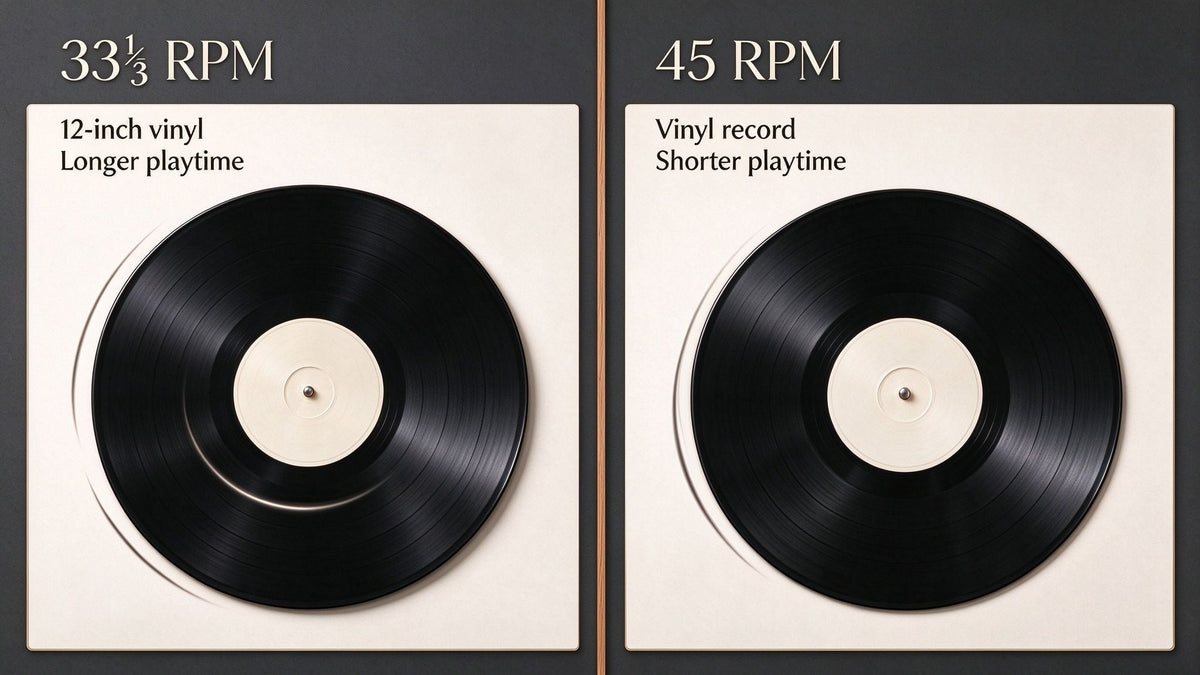
Most records you'll encounter as a beginner are designed to play at one of two speeds:
-
33⅓ RPM
-
45 RPM
RPM means revolutions per minute.
Most modern home turntables support both speeds, and for most buyers, that's all you need to worry about.
Older records, particularly some shellac records, may use 78 RPM. If you collect vintage records, check whether your collection requires a turntable that supports this speed. For most modern vinyl collections, however, 33⅓ and 45 RPM are the important ones.
Why Speed Matters
A record is cut to play at a specific rotational speed.
If the platter rotates too quickly, the music plays faster and the pitch rises.
If it rotates too slowly, the music plays slower and the pitch drops.
That's why speed consistency matters.
When comparing turntables, don't only look for "33/45 RPM" in the specifications. If the manufacturer provides information about speed stability or wow and flutter, those specifications can tell you more about how consistently the platter maintains its intended speed.
Wow and flutter describe small variations in playback speed that can affect pitch stability. You don't need to become an expert in the measurement to use it as a comparison point: when manufacturers publish a lower wow-and-flutter figure, it generally indicates tighter speed stability under the specified measurement conditions.
A Beginner's Rule
Don't obsess over specifications you don't understand.
But don't ignore the fundamentals either.
Before buying, check that the turntable:
-
Supports 33⅓ and 45 RPM
-
Maintains stable, consistent rotation
-
Provides published speed-stability or wow-and-flutter specifications if available
-
Offers convenient speed switching if that's important to you
For most record collections, support for 33⅓ and 45 RPM is enough.
The goal isn't to find the turntable with the most impressive specification sheet. It's to find one that maintains stable speed and supports the records you actually own.
5. Decide Whether You Need a Phono Preamp
This is one of the most common sources of confusion for first-time turntable buyers.
A turntable cartridge produces a very small electrical signal. A phono preamp, also called a phono stage, amplifies that signal and applies the standard RIAA equalization needed for playback before the signal reaches a normal line-level input.
In practical terms, your system needs an appropriate phono stage somewhere in the signal path.
That phono stage can be built into the turntable, built into an amplifier or receiver, or provided by a separate external component.
Built-In Phono Preamp
Some turntables include a built-in phono preamp.
This can simplify setup considerably because the turntable can output a standard line-level signal.
Depending on the equipment, you may be able to connect the turntable directly to:
-
Powered speakers
-
An amplifier's line-level input
-
Compatible wireless equipment
For beginners, a built-in phono stage can eliminate an additional component and make the system easier to set up.
External Phono Preamp
A separate phono preamp gives you more flexibility.
You can choose the phono stage independently from the turntable and other components, and you can upgrade it later without replacing the rest of your system.
This approach is more common in traditional component-based systems, especially when the turntable and amplifier don't already include a suitable phono stage.
A separate phono preamp isn't automatically better, however. For a beginner, the main advantage is flexibility, not simply having another component.
Phono Input on an Amplifier
Some amplifiers and receivers include a dedicated PHONO input.
If yours does, you may not need a separate external phono preamp because the amplifier already contains the required phono stage.
This is why it's important to check the connections on all of your components before buying additional equipment.
Avoid Using Two Phono Stages
Your system generally needs one active phono stage in the signal path.
For example, if your turntable has a built-in phono preamp and it is switched on, connect the turntable to a normal line-level input such as LINE or AUX, depending on your equipment.
If you connect that same signal to a dedicated PHONO input, you may be running the signal through two phono stages, which can result in incorrect gain and equalization.
If your turntable has a built-in phono stage that can be switched off, you can instead use the amplifier's PHONO input with the turntable's phono stage disabled.
Always check the manufacturer's instructions if the connections are unclear.
The Beginner's Rule
Before buying a turntable, identify where the phono stage will be in your system:
Turntable with built-in phono stage → line-level input
Turntable without built-in phono stage → external phono preamp or amplifier with PHONO input
Once you know where the phono stage is located, the rest of the connection path becomes much easier to understand.

For a deeper explanation, see AUDURA's guide What Is a Phono Preamp? Do You Need One for Your Turntable?
6. Understand the Cartridge and Stylus
The cartridge matters, but it should be considered as part of the entire playback system.
A good cartridge cannot compensate for problems elsewhere in the setup, including:
-
Incorrect tracking force
-
Poor cartridge alignment
-
A dirty record
-
A worn stylus
-
Excessive vibration
-
Poor turntable placement
-
Limitations elsewhere in the amplification or speaker system
Vinyl playback is a system.
The cartridge works together with the tonearm, platter, motor, phono stage, amplifier, and speakers. That's why choosing the most expensive cartridge isn't necessarily the best way to improve your listening experience.
What Should a Beginner Look For?
For a first turntable, a properly installed, well-matched cartridge is often more important than choosing the most expensive cartridge available.
A pre-installed cartridge is usually the easiest option.
It means you can start listening without having to learn cartridge alignment before you've even played your first record.
It's also worth checking whether the cartridge uses a replaceable stylus.
Over time, styli wear as they make contact with the record groove. Being able to replace the stylus without replacing the entire cartridge can make routine maintenance simpler and more cost-effective.
For beginners, look for:
-
A reputable, properly matched cartridge
-
Correct factory setup or straightforward alignment
-
A replaceable stylus, when available
-
Replacement stylus availability
-
A cartridge that can be serviced or upgraded as your needs change
You don't need to choose a cartridge based on specifications alone. Compatibility, setup, and long-term maintenance are just as important.
Don't Forget Stylus Care
The stylus is the part of the cartridge that physically follows the record groove, so keeping it clean and in good condition is essential for consistent playback.
Dust and debris can affect playback, and a worn stylus should eventually be replaced.
Regular, gentle cleaning is a simple but important part of vinyl maintenance.
If you want to understand the difference between a cartridge and a stylus in more detail, see AUDURA's guide What Is a Turntable Stylus? Stylus vs. Cartridge Explained.
7. Understand the Tonearm
The tonearm supports the cartridge and allows the stylus to follow the record groove.
You don't need to become an expert in tonearm engineering to choose a good turntable.
But there are a few things worth understanding, especially if you're comparing turntables with different levels of adjustment.
Tracking Force
Tracking force is the downward force with which the stylus tracks the record groove.
Every cartridge has a recommended tracking-force range, and the correct setting should come from the cartridge manufacturer.
Don't simply copy the setting from another turntable or cartridge because the equipment looks similar. Different cartridges can require different tracking forces.
For a beginner, a turntable with a properly configured tracking system can make setup much easier.
Anti-Skate
As the record spins, the stylus and tonearm experience an inward skating force.
Anti-skate applies a small outward compensating force to help the stylus track the groove properly.
Like tracking force, anti-skate should be set according to the turntable and cartridge manufacturer's recommendations rather than guessed.
Adjustable vs. Simplified Tonearms
More adjustment isn't necessarily better.
An experienced enthusiast may appreciate features such as:
-
Adjustable tracking force
-
Adjustable anti-skate
-
Cartridge alignment options
-
Replaceable cartridges and headshells
A beginner, however, may prefer a turntable with simpler setup, factory-adjusted settings, or clearly documented adjustment procedures.
That's an important distinction.
A feature is only useful if you can use it properly.
When comparing turntables, don't automatically choose the model with the most adjustment points. Consider how much control you actually want—and how comfortable you are using it.
If you're new to turntable setup, AUDURA's How to Set Turntable Tracking Force and Anti-Skate: A Beginner's Guide can walk you through the fundamentals.
8. Choose the Connectivity You Actually Need
Modern turntables can offer far more connectivity than you might expect.
You may see RCA, Bluetooth, USB, optical, and other connection options listed in the specifications. But more connections don't automatically make a turntable better.
The better question is:
What do you actually need to connect?
Start with your existing speakers, amplifier, headphones, and other audio equipment. Then choose a turntable that supports the connections your system requires.
RCA
RCA is one of the most common analog connections for home audio.
Depending on the turntable and the rest of your system, RCA can connect a turntable to:
-
Powered speakers
-
Integrated amplifiers
-
Receivers
-
External phono preamps
For a traditional wired setup, RCA remains a simple and practical connection.
If you're building a conventional vinyl system, RCA compatibility is one of the first things worth checking.
Bluetooth
Bluetooth can make a turntable easier to integrate into a modern wireless setup.
Depending on the product, Bluetooth may allow you to send vinyl audio to compatible:
-
Wireless speakers
-
Headphones
-
Sound systems
This can be particularly convenient in apartments, smaller rooms, or spaces where running additional speaker cables isn't practical.
But Bluetooth isn't automatically better than a wired connection.
It is simply a different way to build your system.
One important detail: check what the Bluetooth connection actually does.
For a turntable, Bluetooth may be designed primarily for audio output to compatible wireless devices. A Bluetooth-enabled turntable does not necessarily work as a Bluetooth speaker that receives music from your phone.
If wireless listening is important to you, make sure the turntable supports the specific Bluetooth function you need.
USB
USB is mainly useful if you want to connect the turntable to a computer or create digital recordings of your vinyl.
For example, you might use USB to:
-
Digitize selected records
-
Archive rare or hard-to-replace albums
-
Edit or manage digital recordings on a computer
But USB is a specialized feature for most listeners.
If you have no interest in digitizing your records, don't pay extra simply because a turntable includes USB.
Optical
Optical output can be useful when connecting a turntable to compatible digital audio equipment, such as certain soundbars, active speakers, or other devices with an optical input.
This can be useful if your existing system is built around digital connections rather than traditional analog RCA inputs.
However, optical isn't something every beginner needs.
Before choosing a turntable with optical output, check that the device you want to connect actually has a compatible optical input and that the turntable's signal path supports the way you intend to use it.
A Simple Buying Rule
Don't choose a turntable because it has the longest specification list.
Choose it because its connections match your system.
Before you buy, ask:
-
Do I need a wired RCA connection?
-
Do I want to use Bluetooth speakers or headphones?
-
Do I want to digitize records through USB?
-
Does my existing audio system require optical?
-
Are these connections inputs or outputs, and do they work the way I expect?
If you don't need a particular connection, you don't need to pay extra for it.
Buy the connectivity that fits your system today—not a list of features you may never use.
9. Think About Your Speakers Before Buying Your Turntable
One of the most common surprises for first-time turntable buyers is discovering that the turntable is only one part of the system.
You buy a turntable.
Then you realize you need speakers.
Then you discover that passive speakers need an amplifier.
And depending on the equipment you choose, you may also need a phono preamp.
What seemed like a simple purchase can quickly become a complete audio system.
The easiest way to avoid surprises is to think about the entire signal chain before you buy.
Powered Speakers
Powered speakers have built-in amplification, so they don't require a separate amplifier.
This makes them a practical partner for a turntable, provided the turntable and speakers have the appropriate connections and the system includes a suitable phono stage where required.
A simple setup might look like:
Turntable → Powered Speakers
Or, if the turntable does not have a built-in phono stage:
Turntable → Phono Preamp → Powered Speakers
This approach offers a good balance between simple setup, separate stereo speakers, and relatively low system complexity.
Passive Speakers
Passive speakers do not contain their own power amplifier.
They need to be connected to an amplifier or receiver.
A typical system might look like:
Turntable → Amplifier → Passive Speakers
If the turntable or amplifier does not include a phono stage, you may also need:
Turntable → Phono Preamp → Amplifier → Passive Speakers
The advantage is greater component flexibility.
You can choose and upgrade the amplifier, speakers, phono stage, cartridge, and turntable independently over time.
The trade-off is that the system requires more components, more connections, and more space.
Built-In Speakers
An all-in-one record player can combine the turntable, amplifier, and speakers in a single enclosure.
This is the simplest approach.
You don't need to plan a separate speaker system, and there are fewer components and cables to manage.
The trade-off is flexibility.
Because the speakers are built into the same enclosure, you have less freedom to position them separately in the room. Future upgrades are also more limited because the turntable and speakers are designed as part of the same system.
For casual listening or smaller spaces, however, that simplicity can be exactly what you want.
Which Setup Is Right for You?
Think about how much equipment you want and how much flexibility you expect to need.
Maximum simplicity:
All-in-one record player.
Simple stereo system:
Turntable + powered speakers.
Most upgrade flexibility:
Turntable + amplifier + passive speakers.
None of these setups is inherently better.

The right choice depends on whether you prioritize simplicity, separate stereo speakers, or the ability to upgrade individual components over time.
And remember: more equipment does not automatically mean a better listening experience.
The goal is to build a system that is easy for you to use, works with the equipment you already own, and gives you room to grow if your interests change.
10. Consider Your Room and Living Space
Your listening environment should influence the system you choose.
A turntable that works well in a dedicated listening room may be unnecessarily large or complicated for a small apartment. Likewise, a compact all-in-one system may not be the best choice if you have plenty of space and want to build a more flexible stereo system.
Before you buy, think about where the turntable will live, where the speakers will go, and how much space you actually have to work with.
Small Apartments
When space is limited, simplicity and placement become especially important.
Look for:
-
A footprint that fits your furniture
-
Stable, level placement
-
Practical cable management
-
Enough room to operate the tonearm
-
Speaker placement that doesn't compromise the room
-
A system that doesn't create unnecessary visual clutter
Wireless connectivity can also be useful if running speaker cables across the room would be inconvenient.
However, don't choose wireless connectivity simply because you live in a small space. First consider how you want the system to sound and connect, then use wireless features where they genuinely make the setup easier.
If you're setting up vinyl in a smaller home, AUDURA's Small Apartment Vinyl Setup Ideas can provide additional guidance.
Living Rooms
For many listeners, the living room is both the listening space and the main living space.
That means your audio system needs to work with the furniture you already have.
A turntable might sit on a:
-
Media console
-
Sideboard
-
Record cabinet
-
Dedicated audio stand
Whatever you choose, make sure the surface is stable, level, and large enough for the equipment.
Leave enough space to comfortably:
-
Place and remove records
-
Operate the tonearm
-
Open the dust cover, if equipped
-
Access power and audio connections
-
Keep cables from becoming tangled or strained
Don't forget about the speakers.
Separate speakers generally give you more freedom to create a stereo listening position, but they also require more floor or shelf space. Before buying, make sure your room can accommodate both the turntable and the speaker placement your system requires.
Dedicated Listening Rooms
If you have a dedicated listening room, you have more freedom to optimize the entire system.
You can place greater emphasis on:
-
Speaker positioning
-
Listening position
-
Equipment placement
-
Vibration control
-
Room acoustics
-
Future system upgrades
A dedicated room can also make it easier to separate the turntable from speakers and other potential sources of vibration.
But you don't need a dedicated listening room to enjoy vinyl properly.
A well-planned setup in a living room, bedroom, office, or apartment can work very well. Good placement matters more than having a "perfect" room.

The Beginner's Rule
Choose the system around the space you actually have—not the room you imagine you might have someday.
Before buying, measure your available space and think about the complete setup:
Turntable + speakers + listening position + storage + cable clearance
The best turntable for your home is one that fits comfortably into your room and is easy to use every time you want to play a record.
11. Turntable Placement Matters More Than Many Beginners Expect
Even a well-designed turntable can be affected by poor placement.
Your turntable doesn't need a specialized audiophile rack to work properly. But it does need a stable, reasonably level surface that isn't easily disturbed by movement or vibration.
Good placement is one of the simplest things you can get right—and it doesn't have to cost much.
Avoid Unstable Furniture
Try not to place a turntable on furniture that:
-
Wobbles when touched
-
Vibrates easily
-
Is visibly uneven
-
Moves when someone walks nearby
-
Shares a surface with equipment that generates significant vibration
A sturdy media console, sideboard, shelf, or audio stand can all work well as long as the surface is stable and appropriate for the equipment.
Keep Speakers Away From the Turntable When Possible
Speakers produce sound energy and physical vibration.
If the turntable is placed directly on the same unstable surface as a speaker, those vibrations can travel through the furniture and potentially contribute to unwanted feedback or low-frequency noise.
This can become more noticeable as listening volume increases.
Whenever possible, give the turntable and speakers their own stable positions.
You don't necessarily need a large room or expensive isolation equipment. Simply separating the turntable from the main source of vibration can already make a meaningful difference.
Make Sure the Turntable Is Level
The turntable should sit on a reasonably level surface so that the platter and tonearm can operate as intended.
If you're unsure whether your furniture is level, a small bubble level can help you check it.
You don't need to turn this into a laboratory experiment.
The goal is simply to provide the turntable with a stable, level, low-vibration foundation.
Leave Enough Working Space
Placement isn't only about vibration.
Make sure you have enough room to comfortably:
-
Place and remove records
-
Operate the tonearm
-
Open the dust cover, if equipped
-
Reach the controls
-
Access power and audio cables
A turntable squeezed into a narrow shelf may technically fit, but that doesn't necessarily make it a good listening setup.
The Beginner's Rule
Before buying a turntable, think about where it will actually sit.
Choose a location that is:
Stable + level + low-vibration + easy to access
If you experience unwanted low-frequency noise, humming, or feedback after setting up your system, AUDURA's How to Stop Turntable Feedback and Vibration: A Beginner's Guide is a useful next step.
A good turntable doesn't need an elaborate setup.
It simply needs a sensible place to live.
12. Manual or Automatic?
Another decision to consider is how much of the playback process you want to control yourself.
Unlike drive type or phono connectivity, this isn't primarily a technical decision.
It's about how you want to interact with your records.
Manual Turntables
With a manual turntable, you control the main playback steps yourself:
-
Place the record on the platter.
-
Start the platter.
-
Move the tonearm into position.
-
Lower the stylus onto the record.
-
Lift the tonearm when playback finishes.
For many listeners, this is part of the appeal of vinyl.
You physically start the record, lower the stylus, and become more involved in the listening process.
If you enjoy that hands-on ritual, a manual turntable can feel natural and rewarding.
The trade-off is that you need to pay attention when starting and finishing a record.
Automatic Turntables
Automatic turntables can handle some of the tonearm movement for you.
Depending on the design, the turntable may automatically:
-
Move the tonearm into position
-
Lower the stylus
-
Return the tonearm when the record finishes
-
Stop the platter
This can be especially useful if:
-
You're completely new to vinyl
-
You prefer convenience
-
You don't want to manually cue the tonearm
-
You sometimes want to start a record without managing every step yourself
Automatic operation doesn't mean you have no control. You still need to choose the correct record speed, place the record properly, and take care of the stylus and records.
What About Semi-Automatic Turntables?
A semi-automatic turntable sits somewhere between the two.
You may still manually place and cue the tonearm, while the turntable automatically returns the tonearm or stops the platter when the record finishes.
This can be a useful option if you enjoy the physical ritual of starting a record but don't want to worry about leaving the stylus sitting in the run-out groove after playback.
Which Is Better?
Neither manual nor automatic operation is inherently better.
Automation is not a reliable indicator of sound quality, build quality, or overall turntable quality.
Instead, think about what you value most:
More hands-on control:
Choose manual.
A balance of ritual and convenience:
Consider semi-automatic.
Maximum convenience:
Consider automatic.
The right choice is simply the one that fits the way you want to use your turntable.
Vinyl doesn't have to be complicated. The best level of automation is the one that makes you want to play records more often.
13. Don't Pay for Features You Won't Use
Turntables can come with a surprisingly long list of features.
You may see:
-
Bluetooth
-
USB
-
Optical output
-
Built-in phono preamp
-
Automatic operation
-
Auto-stop
-
Multiple speeds
-
Replaceable cartridges or styli
-
Adjustable tonearms
-
Pitch controls
-
Radio
-
Additional inputs or outputs
It's tempting to assume that more features automatically mean more value.
They don't.
A feature only adds value if it solves a problem you actually have or makes your system more useful.
Create Three Lists
Before you start comparing turntables, divide the features into three categories:
Must have
Features your system genuinely requires.
Nice to have
Features that would make your setup easier or more convenient.
Don't care
Features you probably won't use and don't need to pay extra for.
This simple exercise can make a surprisingly big difference.

Example
Your own list might look something like this:
Must have
-
33⅓ and 45 RPM support
-
A suitable phono connection for your system
-
A replaceable stylus, if you want straightforward long-term maintenance
-
The connections required by your speakers or amplifier
Nice to have
-
Bluetooth
-
Auto-stop or automatic operation
-
USB
-
Optical connectivity
-
Adjustable tonearm settings for future upgrades
Don't care
-
DJ-oriented pitch controls
-
Radio, if you already have other ways to listen to broadcasts
-
Connections for equipment you don't own
-
Features you don't understand or don't expect to use
Notice that the "Must have" list depends on your system.
For example, a built-in phono preamp isn't automatically a must-have. If your amplifier already has a PHONO input, or you plan to use an external phono preamp, you may not need one inside the turntable.
The same principle applies to Bluetooth, USB, optical, and other connectivity options.
Use Your Own System as the Checklist
Instead of asking:
"Which turntable has the most features?"
Ask:
"Which features do I actually need for the system I'm building?"
That question makes comparing turntables much easier.
It can also prevent you from paying for features that sound impressive on a specification sheet but have little practical value in your home.
The goal isn't to buy the turntable with the longest feature list. It's to buy the turntable with the right features for you.
14. Set a Budget for the Entire System
One of the most common mistakes first-time buyers make is thinking only about the price of the turntable.
A $300 turntable does not necessarily mean you're building a $300 vinyl system.
If you still need speakers, amplification, a phono stage, or other accessories, your actual budget will be higher.
Think in terms of total system cost, not just the turntable price.
Your system may include:
-
Turntable
-
Speakers
-
Amplifier or receiver, if needed
-
Phono preamp or phono stage, if needed
-
Cables
-
Record-cleaning supplies
-
Replacement stylus
-
Other accessories your setup requires
You don't necessarily need to buy everything separately. Some turntables include a phono stage, and powered speakers include their own amplification. All-in-one systems can combine even more components.
The important thing is to understand the complete cost of the setup you're actually building.
Don't Automatically Buy the Cheapest Option
A very inexpensive record player can be attractive because the initial price is easy to understand.
But if you plan to listen regularly, look beyond the purchase price.
Consider:
-
Stylus replacement availability
-
Cartridge and stylus quality
-
Tonearm design
-
Speed stability
-
Build quality
-
Warranty coverage
-
Availability of replacement parts
-
Long-term serviceability
The cheapest turntable isn't necessarily the cheapest option over several years if replacement parts are difficult to find or the system doesn't suit your needs.
Don't Automatically Buy the Most Expensive Option
The opposite mistake is spending more simply because a higher price must mean a better experience.
It doesn't.
If you're listening casually in a bedroom through a compact speaker system, spending thousands on a turntable may not be the most effective way to improve your overall setup.
Your speakers, room, phono stage, cartridge, and other components all contribute to the final result.
That's why a balanced system is usually a better goal than putting most of your budget into a single component.
Think in Terms of the Complete System
Before you decide how much to spend on the turntable itself, ask:
What is my total budget for the entire vinyl system?
Then work backward.
If you already own an amplifier and speakers, you may be able to put more of your budget toward the turntable.
If you're starting from scratch, an all-in-one system or turntable with powered speakers may give you a simpler path to getting everything you need.
There is no universal "correct" turntable budget.
The right amount depends on your system, your listening habits, and how seriously you want to invest in the hobby.
For a more detailed breakdown of price ranges and what you can reasonably expect at different budgets, see AUDURA's How Much Should You Spend on Your First Turntable? A Beginner's Budget Guide. [First Turntable Budget Guide]
Don't ask, "How much should I spend on a turntable?" Ask, "How much should I spend on the vinyl system I actually want?"
15. Think About the Next Two Years, Not Just Today
You don't need to predict your entire audio future before buying your first turntable.
But it is worth thinking about how your system might change if you become more interested in vinyl.
A good first setup should work well for you today without unnecessarily limiting your options tomorrow.
Ask Yourself a Few Questions
Before you buy, consider:
-
Will I eventually want better speakers?
-
Will I want to try a different cartridge or stylus?
-
Might I want a separate phono preamp later?
-
Will I want to add wireless connectivity?
-
Could I expand the system with a subwoofer or other audio equipment?
-
Am I likely to collect more records?
-
Might I move to a larger or different room?
-
Would I ever want to digitize some of my records?
You don't need a turntable that supports every possible upgrade.
In fact, trying to future-proof every decision can make your first purchase unnecessarily complicated and expensive.
Instead, look for reasonable upgrade flexibility.
For example, if you already know that you enjoy experimenting with audio equipment, a turntable with adjustable settings and replaceable components may give you more room to grow.
If you simply want an easy system that plays records reliably, additional upgrade options may not matter very much.
Avoid Buying Into a Dead End
The goal isn't to predict exactly what you'll want two years from now.
It's to avoid buying a system that becomes frustrating as soon as your interests change.
Before buying, ask:
"If I become more serious about vinyl, what would I want to change first?"
If the answer is "probably nothing," a simple system may be exactly right.
If the answer is "I'd want to upgrade the speakers, cartridge, or phono stage," look for a system that allows those components to be changed independently.
Two Very Different Beginners
Imagine two listeners.
Listener A wants to play a few records every weekend and doesn't care much about audio equipment.
An all-in-one system may be exactly right.
It gives them a simple way to enjoy vinyl without adding components they don't need.
Listener B loves music equipment and already expects to experiment with speakers, cartridges, and other components.
A more modular turntable system makes more sense.
It gives them more control and more opportunities to upgrade over time.
Neither listener is more "serious."
They simply have different goals.
The best first turntable is not the one with the most upgrade potential. It's the one that gives you the right amount of flexibility for the way you expect to use it.
16. A Practical Turntable Buying Checklist
Before you click "Buy," take two minutes to run through this checklist.
You don't need to understand every turntable specification. You simply need to make sure the turntable fits your listening habits, your system, your space, and your budget.
Your Listening Habits
- I know where the turntable will live.
- I know how often I expect to use it.
- I know whether I want maximum simplicity or more system flexibility.
- I know whether I prefer manual, semi-automatic, or automatic operation.
Your Audio System
- I know which speakers I will use.
- I know whether I need an amplifier.
- I know where the phono stage will be in my signal chain.
- I know which connection I will use.
- I have confirmed that all of my components are compatible.
The Turntable
- It supports the record speeds I need.
- It provides stable, consistent rotation.
- The cartridge is appropriate for the turntable and my system.
- The stylus can be replaced, and replacement styli are available.
- The tonearm and its adjustments are appropriate for my experience level.
- It has the connections and features I actually need.
- I am not paying extra for features I don't expect to use.
The Room
- I have a stable, reasonably level surface.
- The turntable can be placed away from significant sources of vibration.
- The speakers can be positioned sensibly for the space.
- I have enough room to operate the tonearm and access the controls.
- I have considered where my records and other equipment will be stored.
Budget and Long-Term Ownership
- I know my total system budget, not just my turntable budget.
- I have accounted for speakers, amplification, a phono stage, and other equipment I may need.
- Replacement styli are available.
- Important parts can be maintained or replaced.
- Warranty information is clear.
- The system gives me enough upgrade flexibility for how I expect to use it.
The Final Question
Before you buy, ask yourself one last question:
"Does this turntable fit the system I actually want to live with?"
If the answer is yes—and you've checked the important boxes above—you don't need to keep searching for a specification sheet with more features.
You're ready to compare specific models based on fit, quality, design, features, and value.
The best turntable isn't the one that checks every possible box. It's the one that checks the right boxes for you.
17. Common Turntable Buying Mistakes
Even after you understand the basics, it's easy to make a few common mistakes when choosing your first turntable.
Most of them aren't caused by a lack of technical knowledge.
They're caused by focusing on the wrong thing.
#1. Buying Based Only on Appearance
A beautiful turntable can make a room feel better.
That's valuable.
Your audio system is part of your living space, and design matters—especially if the turntable will be visible every day.
But aesthetics shouldn't replace basic compatibility.
Before choosing a turntable because you love how it looks, make sure it works with:
-
Your speakers
-
Your amplifier, if you use one
-
Your phono stage
-
Your available connections
-
Your available space
Choose a turntable you enjoy looking at—but make sure you can actually build the right system around it.
#2. Buying the Turntable Before Considering the Speakers
It's easy to focus on the turntable because it's the centerpiece of a vinyl setup.
But the turntable is only one part of the signal chain.
If you buy the turntable first and think about speakers later, you may end up needing an amplifier, phono preamp, additional cables, or other equipment you didn't originally plan to buy.
Before you purchase, think through the complete system:
Turntable → Phono Stage → Amplification → Speakers
Not every system will use every component separately, but the signal path should make sense from beginning to end.
Plan the system first. Then choose the turntable that fits it.
#3. Assuming Bluetooth Automatically Means Better Sound
Bluetooth can be extremely convenient.
It can make it easier to connect a turntable to compatible wireless speakers or headphones, particularly when you don't want to run speaker cables across a room.
But wireless doesn't automatically mean better sound—and wired doesn't automatically mean better either.
Bluetooth is primarily a connectivity choice.
Choose it because it makes your system more useful, not because the word "Bluetooth" appears on the specification sheet.
#4. Spending Most of Your Budget on the Turntable
It's tempting to put most of your budget into the centerpiece of the system.
But a vinyl setup is a system, not a single component.
If you spend nearly everything on the turntable and then have to compromise heavily on speakers, amplification, or other essential components, the result may not be as satisfying as a more balanced system.
This doesn't mean you need to spend the same amount on every component.
It means you should consider the overall balance of the system.
A well-matched, sensibly priced setup can make more sense than an expensive turntable surrounded by components that don't suit it.
#5. Paying for Features You Don't Need
More features can look like better value.
But a turntable with Bluetooth, USB, optical output, automatic operation, multiple adjustments, and other extras isn't necessarily a better choice for you.
If you don't plan to use those features, they may simply add cost and complexity.
Before buying, separate features into:
Must have → Nice to have → Don't need
Then compare models based on your actual requirements.
Buy functionality, not a specification sheet.
#6. Ignoring Setup
Even good equipment can perform poorly when the basic setup is wrong.
Common problems include:
-
The turntable isn't level
-
Tracking force is incorrect
-
Anti-skate is incorrectly adjusted
-
The stylus is dirty or worn
-
The turntable is placed on unstable furniture
-
Speakers are positioned in a way that creates unnecessary vibration
Setup isn't an optional final step.
It is part of the system.
A few minutes spent placing and configuring the equipment correctly can be more valuable than spending extra money on a feature you don't need.
#7. Forgetting Maintenance and Replacement Parts
Vinyl is physical media.
Records collect dust.
Styli wear.
Sleeves age.
Equipment needs occasional care.
Before buying a turntable, think beyond the first day of ownership.
Check whether you can easily find:
-
Replacement styli
-
Compatible cartridges
-
Belts, if applicable
-
Other important replacement parts
-
Clear maintenance instructions
-
Warranty and service information
This matters because a turntable isn't only something you buy.
It's something you expect to use for years.
Good long-term ownership starts with choosing equipment that can be maintained.
#8. Buying for the Listener You Might Become
Future upgrades can be useful.
But trying to "future-proof" your first turntable can also lead you to spend more money and buy more complexity than you actually need.
If you already know that you'll want to experiment with cartridges, phono stages, or other components, some upgrade flexibility is worth considering.
If you simply want to play records at home, a straightforward system may be a better choice.
Don't buy the system you imagine you might want someday.
Buy the system that fits the listener you are today—with enough flexibility for reasonable growth tomorrow.
The Bottom Line
Most first-time turntable mistakes come down to one thing:
Choosing a product before deciding what kind of system you actually want.
Start with your listening habits, room, speakers, budget, and desired level of complexity.
Then choose the turntable that fits those decisions.
That's a much more reliable approach than choosing a model first and trying to build everything else around it.
18. Which Turntable Setup Fits You?
By now, you may have a good idea of what matters when choosing a turntable—but you may still be wondering:
"So what kind of setup actually makes sense for me?"
The easiest way to answer that question is to start with how you want to listen.
"I Want the Easiest Possible Experience."
Consider an all-in-one system.
This is a good fit if you want to take the turntable out, start playing records, and avoid building a system from separate components.
Prioritize:
-
Built-in speakers
-
Simple controls
-
Straightforward setup
-
Compact design
-
Wireless connectivity if useful
Best for: listeners who value convenience and want as few separate components as possible.
The trade-off is less flexibility for future upgrades and speaker placement.
"I Want Simple Stereo Sound."
Consider a turntable with powered speakers.
This gives you separate left and right speakers without requiring a traditional amplifier.
Prioritize:
-
A suitable phono stage in the signal chain
-
RCA connectivity
-
Compact, well-matched powered speakers
-
Flexible speaker placement
-
Bluetooth if it fits your listening habits
Best for: listeners who want a relatively simple system while still benefiting from separate stereo speakers.
"I Want to Build a System Over Time."
Consider a modular turntable system.
This approach gives you more freedom to choose and upgrade individual components as your interests develop.
Prioritize:
-
Replaceable stylus
-
Cartridge compatibility
-
Appropriate tonearm adjustment
-
External phono stage options
-
Upgradeable components
-
Standard connections that work with future equipment
Best for: listeners who enjoy audio equipment and expect their system to evolve over time.
The trade-off is greater complexity, more components, and usually more planning.
"I Live in a Small Apartment."
Your space doesn't necessarily determine which system type you need.
Instead, it should influence how you configure it.
Prioritize:
-
A footprint that fits your furniture
-
Minimal unnecessary wiring
-
Stable, level placement
-
Flexible connectivity
-
Speaker sizes that suit the room
-
Easy access to the turntable and controls
A compact apartment can work with an all-in-one system, powered speakers, or a modular setup.
Choose the system based on how you want to listen, then adapt it to the space you actually have.
"I Care About How My Home Looks."
That's a legitimate part of the decision.
A turntable often lives in a visible part of the home, so its design, proportions, materials, and cable management can matter just as much as its technical specifications from a lifestyle perspective.
Prioritize:
-
Clean, cohesive design
-
Proportions that work with your furniture
-
Minimal visible cable clutter
-
Materials that suit your interior
-
Practical record storage
But don't let appearance replace compatibility.
The best-looking turntable is still the wrong choice if it doesn't work with the system you want to build.
A Simple Way to Decide
If you still aren't sure, start here:
Want maximum simplicity?
→ All-in-one system
Want simple stereo with separate speakers?
→ Turntable + powered speakers
Want maximum upgrade flexibility?
→ Modular turntable system
Have limited space?
→ Choose the system that fits your room, then prioritize compactness and simple connectivity
Care about design?
→ Choose a system that complements your home without compromising compatibility
There is no single "right" turntable setup.
The right choice is the one that balances how you listen, how much complexity you want, the space you have, and how much flexibility you need.
Once you know which setup fits you, choosing the right turntable becomes much easier.
19. Where AUDURA Fits
AUDURA was built around a simple idea:
Modern vinyl should be easy to live with.
That doesn't mean every listener needs the same kind of turntable.
Some people want the simplest possible way to play records. Others want separate stereo speakers. Some want wireless convenience, while others want more control and flexibility as their system evolves.
That's why AUDURA takes a few different approaches to vinyl listening.

AUDURA Play — For the Simplest Setup
If you want the easiest possible way to start listening, AUDURA Play brings the essential parts together in one system.
It combines a belt-drive turntable, built-in stereo speakers, an Audio-Technica AT3600L cartridge, Bluetooth audio playback, and a straightforward setup.
You don't need to add separate speakers or an amplifier to get started.
Best for: listeners who want an all-in-one vinyl system with minimal equipment and simple everyday operation.
AUDURA Pure — For Flexible Everyday Listening
If you want a dedicated turntable but still want to keep your system simple, AUDURA Pure takes a more flexible approach.
It features a belt-drive system, pre-installed Audio-Technica AT3600L cartridge, built-in phono preamp, Bluetooth audio output, switchable PHONO/LINE output, and 33⅓/45 RPM playback.
That allows you to connect compatible powered speakers or build around an existing audio system, while keeping wireless listening available when you want it.
Best for: listeners who want a minimalist standalone turntable with the flexibility to choose how their speakers and audio system are connected.
AUDURA One — For a Complete Home Vinyl System
If you want separate stereo speakers without assembling a traditional multi-component system, AUDURA One combines a belt-drive turntable with dedicated external stereo bookshelf speakers.
It also includes modern listening options such as Bluetooth, FM radio, and USB playback, while the built-in phono stage keeps the system straightforward to set up.
Because the speakers are separate from the turntable, you also have more freedom to position them around the room than you would with an all-in-one design.
Best for: listeners who want a complete home vinyl system with dedicated stereo speakers and modern connectivity.
AUDURA Core — For More Control and Flexibility
If you want a turntable that gives you more control over setup and connectivity, AUDURA Core takes a more feature-rich approach.
Its transparent acrylic construction, carbon-fiber tonearm, adjustable counterweight, Bluetooth 5.3, USB vinyl recording, and multiple wired connection options are designed for listeners who want more flexibility from a dedicated turntable.
Best for: listeners who care about design, enjoy having more control over their setup, and want additional options for connectivity, recording, and future system development.
Which One Fits You?
You don't need to choose the most advanced model.
You simply need to choose the one that matches the way you want to live with vinyl.
Want everything in one system?
→ AUDURA Play
Want a minimalist turntable with flexible wired or wireless connections?
→ AUDURA Pure
Want a complete system with dedicated stereo speakers?
→ AUDURA One
Want more control, connectivity, and setup flexibility?
→ AUDURA Core
The point of this guide isn't to tell everyone to buy the same turntable.
It's the opposite.
Choose the system that fits your life.
If you want simplicity, don't buy complexity just because it sounds more impressive.
If you want flexibility, don't buy a system you'll outgrow immediately.
If you care about design, don't treat your audio equipment as something you have to hide.
A good vinyl setup should work as both an audio system and a natural part of your home.
FAQ
What should I look for when buying a turntable?
Start with your complete vinyl system, not the turntable alone. Consider your speakers, phono stage, connectivity, room, cartridge, stylus replacement, drive type, ease of setup, and how much flexibility you want for future upgrades.
The best turntable for you is the one that fits the system you actually want to build.
What is the best turntable for a beginner?
There is no single best turntable for every beginner.
If you want maximum simplicity, an all-in-one system may be the easiest choice. If you want separate stereo speakers without a traditional amplifier, consider a turntable with powered speakers. If you want to build and upgrade a system over time, a modular turntable setup may be a better fit.
Choose based on how you listen, how much equipment you want, and how much flexibility you need.
Is belt drive or direct drive better for a beginner?
For typical home listening, belt drive is a sensible starting point.
Direct drive can be particularly useful for DJs and listeners who value fast startup, high torque, and direct platter control.
Neither design is automatically better for every listener. Choose based on how you plan to use the turntable.
Do I need a phono preamp with a turntable?
You need an appropriate phono stage somewhere in the signal chain.
It may be:
-
Built into the turntable
-
Built into your amplifier or receiver
-
Provided by a separate external phono preamp
Check your entire system before buying a separate phono preamp. You generally need one active phono stage, not two.
What speakers do I need for a turntable?
You can use either powered speakers or passive speakers.
Powered speakers have built-in amplification, so they can simplify your system.
Passive speakers require a separate amplifier or receiver.
In either case, make sure the system includes an appropriate phono stage and that the connections between the components are compatible.
Is Bluetooth worth having on a turntable?
Bluetooth is worth considering if you already use compatible wireless speakers or headphones, want fewer cables, or prefer a flexible modern setup.
It is a convenience and connectivity feature, not a requirement for enjoying vinyl.
Choose Bluetooth because it fits your lifestyle—not simply because it appears on the specification sheet.
Should I buy a turntable with built-in speakers?
If convenience and simplicity are your top priorities, built-in speakers can make sense.
If you want greater control over speaker placement, stereo separation, and future upgrades, separate powered or passive speakers generally give you more flexibility.
The right choice depends on whether you value simplicity or system flexibility more.
How much should I spend on a first turntable?
There is no universal price that works for everyone.
Start with your total system budget, including the turntable, speakers, amplification, phono equipment, cables, and basic maintenance supplies.
A balanced system is usually more important than putting as much money as possible into the turntable itself.
Is an expensive turntable always better?
No.
A more expensive turntable may offer better components, construction, adjustment options, or connectivity, but its value depends on the rest of your system, your room, your records, and how you actually listen.
A turntable is one part of a larger playback system.
What is a good turntable setup for a small apartment?
A compact turntable with powered speakers or an all-in-one system can work particularly well.
Look for:
-
Stable, level placement
-
A footprint that fits your furniture
-
Simple cable management
-
Speaker placement that works for the room
-
Connectivity that matches your listening habits
You don't need a dedicated listening room to enjoy vinyl. A well-planned setup can work in a small apartment, bedroom, office, or living room.
Should I choose a manual or automatic turntable?
Choose based on how you want to interact with your records.
Manual turntables give you more hands-on control and are popular with listeners who enjoy the traditional playback ritual.
Automatic turntables prioritize convenience and can handle some tonearm movement for you.
Neither is inherently better. The best choice is the level of involvement you actually enjoy.
How often should I replace a turntable stylus?
Stylus life varies depending on the stylus design, condition, tracking setup, record cleanliness, and how frequently you listen.
Rather than replacing a stylus based only on a fixed calendar, pay attention to manufacturer guidance, wear, and changes in playback quality.
When buying a turntable, check whether replacement styli are readily available.
What should I check before buying a turntable?
At minimum, confirm these six things:
-
System compatibility — Does it work with your speakers and amplification?
-
Phono stage — Do you know where the phono stage will be?
-
Connectivity — Does it have the inputs or outputs your system requires?
-
Space — Do you have a stable, level place to use it?
-
Maintenance — Can you replace the stylus and obtain important parts?
-
Total cost — Does the complete system fit your budget?
If those six areas make sense, you're in a much better position to compare specific turntables.
Conclusion
Choosing a turntable doesn't have to begin with a list of specifications.
It should begin with your life.
Where will you listen?
How often?
How much equipment do you want in the room?
Do you want the ritual of a manual turntable or the convenience of automation?
Do you want a system you can upgrade over the years, or something simple that lets you start listening tonight?
Once you answer those questions, the technical choices become much easier.
Choose the system first.
Then choose the turntable that fits it.
Think about the connections you need, the speakers you'll use, where the turntable will live, how much flexibility you want, and how much complexity you're comfortable managing.
And remember: there is no single best turntable for everyone.
The right turntable is the one that fits your home, your listening habits, and the way you want to experience your records.
More importantly, it should make you want to put another record on.
If you're continuing your vinyl journey, explore AUDURA's Vinyl 101 guides for practical advice on turntable setup, phono preamps, speakers, stylus care, record cleaning, and vinyl storage. Each guide covers another part of building a system that sounds good, feels natural to use, and fits comfortably into modern life.
Vinyl doesn't need to make your life more complicated.
A good setup should make listening easier.