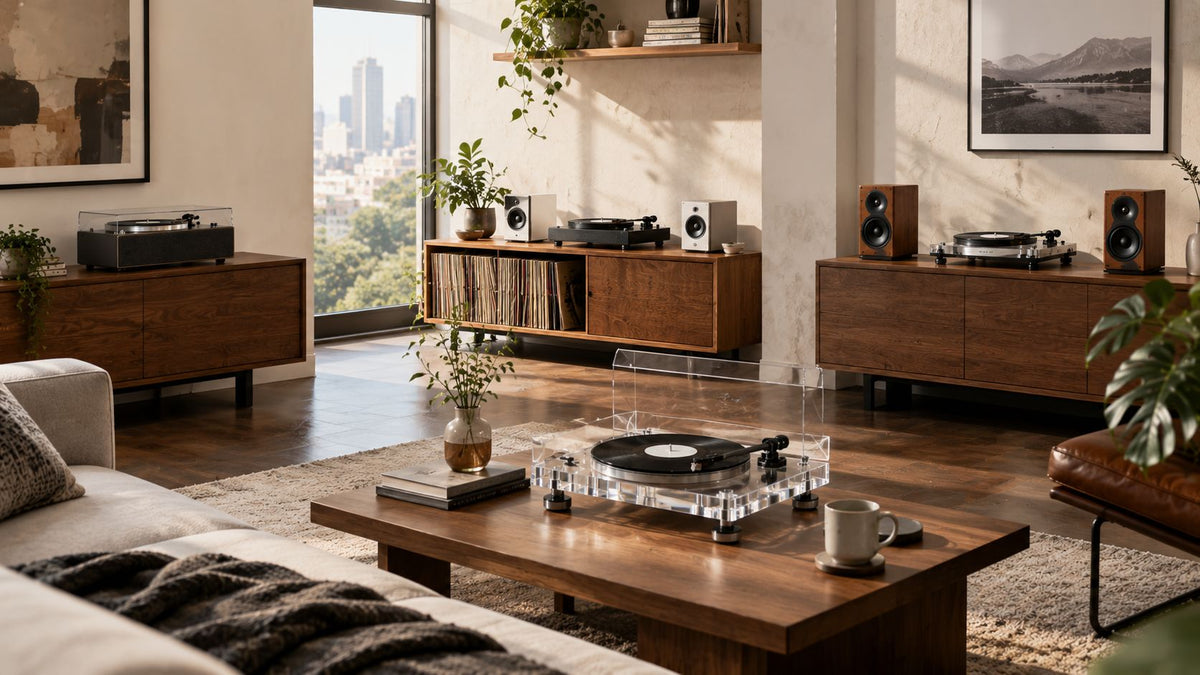
Turntable Buying Guide: Find the Right Setup for You
Introduction
There is no single “best” turntable for everyone.
The right choice depends on how you actually plan to listen.
You might want to play a few favorite records on Sunday mornings without turning your living room into a hi-fi project. You might live in a smaller space and value a simple, compact setup. You may already own speakers and want a turntable that gives you more flexibility as your system evolves. Or you may be building a more intentional listening space where sound, equipment, and interior design all matter.
These are different listening styles, and they can lead to very different buying decisions.
That is why choosing a turntable by specifications alone can be misleading. Bluetooth connectivity, built-in or external phono preamps, cartridge design, belt drive, speaker requirements, and wireless options all matter—but their importance depends on how you plan to use your system.
In this turntable buying guide, we will look at common listening styles and explain what to prioritize for each one. You will learn which features are worth paying attention to, which ones you may not need, what beginners often overlook, and how to match your turntable and audio setup to your space, habits, and long-term listening goals.
The goal is simple: choose the system that fits the way you listen—not the one with the longest specification sheet.
1. Start With Your Listening Style, Not the Turntable
One of the easiest mistakes when buying a turntable is to start by comparing models.
It feels logical. Open a few product pages, compare cartridges, connectivity, platter materials, tonearms, and prices, then choose the one with the most impressive list of features.
But a turntable is only one part of a larger listening system.
Before deciding which model to buy, ask a more useful question:
What does listening to vinyl actually look like in my home?
Do You Listen to Complete Albums?
If you regularly sit down and listen from the first track to the last, you may care more about playback stability, cartridge performance, speaker placement, and the overall listening environment.
You are not simply looking for a record player.
You are building a listening experience.
For this type of listener, it may make sense to choose a dedicated turntable and pair it with a dedicated stereo speaker system—or choose a complete vinyl system that brings the essential components together.
Is Vinyl Part of Your Everyday Routine?
For some people, vinyl is not an event.
It is what plays while making coffee, cooking dinner, reading, or relaxing after work.
If that sounds familiar, convenience becomes more important.
You may value:
-
Simple controls
-
Quick setup
-
Bluetooth connectivity
-
A complete or integrated speaker solution
-
Easy source switching
-
Minimal cables
-
A system that looks natural in your living space
For this type of listener, a highly customizable audiophile system may introduce more complexity than you actually need.
The goal is not to eliminate flexibility. It is to choose the right level of flexibility for the way you listen.
Do You Treat Vinyl as a Hobby?
For collectors and enthusiasts, the turntable can become part of the hobby itself.
You may want to change cartridges, experiment with speaker placement, upgrade individual components, or fine-tune tracking and alignment.
In this case, flexibility becomes more important than having everything integrated into a single system.
It is also worth thinking beyond the initial purchase. Consider how much control you want today—and how much flexibility you may want as your system evolves.
Is Your Turntable Also Part of Your Interior?
This is increasingly relevant for modern vinyl listeners.
A turntable often sits in a living room, bedroom, office, or another visible part of the home. It is not simply audio equipment—it can become part of the room itself.
If your listening space has a minimalist aesthetic, the equipment you choose can influence the overall feel of the space.
That means dimensions, finish, cable management, speaker placement, and visual simplicity may matter alongside technical specifications.
For many listeners, the right setup is one that sounds at home in both their audio system and their living space.
The best turntable is not necessarily the most advanced one. It is the one that makes sense for your listening habits, space, and priorities.
2. The Four Main Vinyl Listening Styles
Most vinyl listeners fall somewhere between several categories, but it helps to start with four common listening styles.

| Listening Style | What Matters Most | Ideal Setup |
|---|---|---|
| The Simple Listener | Ease and convenience | Complete vinyl system |
| The Modern Minimalist | Wireless flexibility and design | Minimalist turntable with wireless connectivity |
| The System Builder | Flexibility and upgrade potential | Dedicated turntable + separate components |
| The Intentional Listener | Stereo performance and control | Turntable + dedicated stereo system |
These are not levels of quality.
One setup is not automatically “better” than another. The right choice depends on how you listen, how much control you want, and how the system needs to fit into your space.
Someone who wants a record playing while cooking dinner does not necessarily need the same setup as someone who spends a Saturday afternoon listening to an entire album.
The right choice starts with the listener—not the specification sheet.
3. Listening Style #1: “I Just Want to Put on a Record”
This is one of the most common reasons people buy their first turntable.
You want the experience of vinyl without turning your setup into a project.
You want to choose an album, place it on the platter, lower the tonearm, and listen.
That’s it.
Best Choice: A Complete Vinyl System
A complete vinyl system combines the essential components you need for record playback into one cohesive setup.
Depending on the design, this may include:
-
Turntable
-
Cartridge
-
Phono preamp
-
Amplification
-
Stereo speakers
-
Wireless connectivity or other audio inputs
The major advantage is simplicity.
Instead of figuring out how a turntable connects to an amplifier, speakers, and other components, the essential parts are already designed to work together.
Why This Setup Works
For a first-time listener, every additional component introduces another decision.
Do I need an amplifier?
Do I need powered speakers?
Do I need a phono preamp?
Which cables do I need?
Will everything work together?
A complete system removes many of those questions.
That does not mean this type of setup is the best choice for every listener. It simply makes a strong match for people whose priority is straightforward, everyday listening rather than building a highly modular audio system.
Who Should Consider a Complete Vinyl System?
This style works particularly well for:
-
First-time vinyl listeners
-
People who do not already own audio equipment
-
Apartment dwellers
-
Casual listeners
-
People with smaller rooms
-
Bedrooms and home offices
-
Listeners who want fewer cables and less setup
-
People who want a visually cohesive system
The Trade-Off
The convenience of a complete system usually comes with less flexibility for component-by-component upgrades.
With a traditional component system, you can replace the speakers without replacing the turntable.
You can change the amplifier.
You can upgrade individual parts as your system evolves.
With a more integrated design, more of the system is built to work together from the start.
That is not necessarily a disadvantage.
It simply means you are prioritizing simplicity and convenience over maximum modularity.
If you already know that you want to experiment with different amplifiers, speakers, and other components, a more flexible system may be a better fit. But if your goal is simply to enjoy your records without building an audio system around them, an integrated setup can make more sense.
A Practical Example
Imagine someone moving into their first apartment.
They have 30 records, a small living room, and very little audio equipment.
They do not want to spend weekends researching amplifiers or comparing speaker configurations.
They simply want to listen to records after work.
For that person, a complete vinyl system can be more appropriate than a complicated component setup.
The best system is the one they will actually use.
4. Listening Style #2: “I Want Vinyl, But I Live in a Small Space”
Apartment living changes the equation.
You may have limited floor space, shared walls, a small media console, or a room that serves several purposes.
In this situation, maximum volume and large components are rarely the priority.
What matters more is how well the entire setup fits into your room and your daily routine.
What Matters in a Small-Space Setup?
Think about:
-
Overall system footprint
-
Speaker placement
-
Cable management
-
Volume control
-
Vibration
-
Listening position
-
Neighbor considerations
-
Ease of use
A good apartment setup does not need to dominate the room.
In fact, a smaller, thoughtfully arranged system can often make more sense than a collection of large components that is difficult to place or live with.
Turntable Placement Matters
Where you place your turntable can affect the listening experience.
Choose a stable, reasonably level surface, and follow a few basic setup principles, and try to avoid locations that are exposed to frequent vibration, foot traffic, or unstable furniture.
If possible, keep the turntable positioned away from the direct output of the speakers rather than placing everything tightly together.
The goal is not to create a perfect listening room. It is to give your turntable a stable home within the space you actually have.
What About Loudness?
More power is not automatically better for an apartment.
If you mainly listen in the evening or at moderate volumes, your priorities may be:
-
Clean sound at comfortable listening levels
-
Good stereo imaging
-
Easy volume control
-
Compact speakers
-
Headphone compatibility
-
Low visual clutter
A thoughtful small-room setup can be much more enjoyable than an oversized system that is difficult to place, difficult to control, or simply takes over the room.
Bluetooth Can Make Sense Here
Bluetooth can be useful when reducing cables and simplifying room layout are major priorities.
A Bluetooth turntable can send audio wirelessly to compatible speakers or headphones, depending on the equipment.
That can make it easier to create a flexible listening setup without running audio cables across the room.
However, wireless convenience should not be confused with “better sound” in every situation.
If maximum wired fidelity and system control are your priorities, a traditional wired connection may make more sense.
If convenience, flexibility, and a clean room layout matter more, Bluetooth can be a practical feature to look for.
A Note on Real-World Apartment Listening
These are not really “audiophile” problems.
They are everyday living problems.
Your available space, furniture, neighbors, listening habits, and tolerance for cables can all influence which turntable setup makes sense.
That is why your room should be part of the buying decision—not an afterthought.
5. Listening Style #3: “I Want Wireless Vinyl”
A modern vinyl setup does not have to look like a traditional hi-fi system.
Your turntable does not necessarily need to sit beside a dedicated amplifier and a pair of wired speakers.
For listeners who already use wireless audio throughout their home, Bluetooth can make vinyl easier to integrate into an existing lifestyle.
What Is a Bluetooth Turntable?
A Bluetooth turntable can send its audio signal wirelessly to compatible Bluetooth equipment.
Depending on the model, that may include:
-
Bluetooth speakers
-
Bluetooth headphones
-
Other compatible wireless audio devices
Connection options vary from one turntable to another, so always check the specifications before buying.
More importantly, think about what you already own and how you want your system to work together.

Why Choose Bluetooth?
The biggest reason is not necessarily sound quality.
It is flexibility.
Bluetooth can make sense if:
-
You already own compatible wireless speakers
-
You want fewer cables
-
You prefer listening with headphones
-
Your room layout makes traditional wiring inconvenient
-
You move your listening setup between spaces
-
You want vinyl to fit naturally into a modern wireless lifestyle
In other words, Bluetooth is less about adding another feature and more about giving you another way to build your system.
Bluetooth Does Not Make Vinyl “Less Real”
There is sometimes an unnecessary debate about whether using Bluetooth defeats the purpose of vinyl.
A better way to think about it is simple:
The record is still the physical source you choose, handle, and play. Bluetooth simply changes how the audio is delivered to your listening equipment.
For some listeners, the physical ritual is the important part.
Choosing a record, opening the sleeve, placing it on the platter, and listening to an album can feel fundamentally different from scrolling through a streaming library.
Wireless connectivity does not have to eliminate that ritual.
It can simply make the rest of the system easier to live with.
When Bluetooth Is Probably Not Your Priority
If you are building a dedicated wired hi-fi system and already have a high-quality amplifier and speakers, Bluetooth may not be essential.
In that case, compatibility with your existing components should come first.
Before buying, ask:
What will this turntable connect to?
Then ask:
How many features does it have?
6. Listening Style #4: “I Already Own Speakers”
If you already have an audio system, you may not need to buy an entire vinyl setup.
Instead, you need a turntable that works with the equipment you already own.
That can make the buying decision more specific—and much easier to narrow down.
Check Your Existing Equipment First
Before shopping, identify:
-
Your speakers
-
Whether they are powered or passive
-
Your amplifier or receiver, if you have one
-
Whether your system has a phono input
-
Whether you need a separate phono preamp
-
Which inputs are available
This quick check can prevent a surprisingly common buying mistake: choosing a turntable that does not match the rest of your audio setup.
Powered Speakers vs. Passive Speakers
Powered speakers have amplification built into the speaker system.
Passive speakers require a separate amplifier.
A simplified setup might look like:
Turntable with a built-in phono preamp → Powered Speakers
Or:
Turntable → Phono Stage → Amplifier → Passive Speakers
Some turntables have a built-in phono preamp, which can simplify the connection to powered speakers or other line-level equipment.
The exact connection depends on the outputs and inputs of your equipment, so always check the specifications of the entire signal chain.
Why This Matters
Imagine buying a turntable because it looks perfect for your room.
Then you get home and realize your amplifier does not have the input you expected—or your speakers require an amplifier you do not have.
The problem is not necessarily the turntable.
The problem is system compatibility.
A turntable can have all the features you want and still be the wrong choice if it does not work with the rest of your setup.
The Better Buying Question
Instead of asking:
“Is this a good turntable?”
ask:
“Is this a good turntable for my existing system?”
That question will usually lead to a better purchase.
7. Listening Style #5: “I Want to Build a System Over Time”
Some listeners know from the beginning that vinyl may become a long-term hobby.
You may start with a few records but expect your collection to grow.
Over time, you may want different speakers, a new cartridge or stylus, a separate phono stage, or other changes to your setup.
For this listener, flexibility matters.
You do not necessarily need the most advanced system on day one. You need a solid foundation that gives you room to explore later.
Look for a Strong Foundation
If you want upgrade flexibility, consider features that make future changes easier.
Useful considerations include:
-
Replaceable stylus
-
Cartridge compatibility
-
Standard RCA connectivity
-
Phono/line output options
-
Compatibility with external speakers and components
-
Availability of replacement styli and compatible parts
The goal is not to buy the most expensive system.
The goal is to avoid buying something that forces you to replace the entire setup when your interests evolve.
A flexible turntable can give you the option to change individual parts as you learn what matters most to you.
Upgrade One Part at a Time
One of the biggest mistakes new enthusiasts can make is trying to upgrade everything at once.
You do not need to replace the turntable, cartridge, speakers, amplifier, cables, mat, record weight, and accessories in the same weekend.
Start with a balanced system.
Then identify the part that genuinely limits your experience.
Maybe your speakers need attention.
Maybe your room placement is the bigger issue.
Maybe your stylus needs replacing.
Maybe you simply need to clean your records.
Good upgrades solve real problems.
They should not exist simply because an accessory looks impressive.

8. Listening Style #6: “I Care About Sound, But I Also Care About My Home”
There is a difference between building an audio system and building an audio system that you actually want to live with.
For many modern vinyl listeners, the turntable sits in a visible part of the home.
It shares space with furniture, books, records, lighting, and everything else that makes a room feel like home.
That means design is not separate from the listening experience.
It is part of how the system fits into your everyday life.
Your Turntable Is Part of the Room
Think about:
-
Furniture proportions
-
Finish and color
-
Cable visibility
-
Speaker size
-
Record storage
-
Lighting
-
Available surface area
A system that sounds good but feels completely out of place may eventually become something you tolerate rather than enjoy.
The goal is to create a setup that works both acoustically and visually within the space you actually live in.

Minimalism Can Be Functional
Minimal design is not simply about removing visual elements.
It can also make a system easier to live with.
A clean setup, intuitive controls, and fewer unnecessary components can make it easier to sit down and listen without feeling like you need to manage an entire audio system first.
That matters because the best audio system is one you use regularly.
Where AUDURA Fits
This is one reason AUDURA approaches turntables as part of modern home living rather than treating the turntable as an isolated piece of equipment.
AUDURA Pure, for example, is designed for listeners who want a dedicated turntable while retaining both wired and wireless flexibility.
With Bluetooth, RCA connectivity, a built-in phono preamp, and a pre-installed Audio-Technica AT3600L cartridge, Pure can work well for someone who already has compatible external speakers or wants the flexibility to build around the turntable over time.
For this type of listener, that can create a useful middle ground between the simplicity of a complete vinyl system and the complexity of a more traditional component-based setup.
The point is not that Pure is automatically the right turntable.
The point is that your audio system should fit both the way you listen and the way you live.
9. Listening Style #7: “I Want the Simplest Complete System”
Some listeners want more than a basic record player, but they also do not want to build a traditional stereo system from separate components.
They want a complete listening experience from the start—without having to choose an amplifier, match speakers, and figure out how everything connects.
This is where a complete vinyl system can make sense.
What Is a Complete Vinyl System?
A complete vinyl system typically brings the essential parts of a home listening setup together:
-
Turntable
-
Cartridge
-
Amplification
-
Stereo speakers
-
Connectivity
The key difference from a more traditional all-in-one record player is that the speakers can be separate from the turntable itself.
That allows the system to remain relatively simple while giving the left and right speakers more physical separation.
Why Separate Speakers Matter
Stereo listening relies on the relationship between the left and right channels.
When the speakers are physically separated, you have more flexibility in creating a wider stereo image and positioning the speakers within the room.
This does not automatically mean that every separate-speaker system will outperform every all-in-one record player.
The advantage is flexibility.
You can place the speakers farther apart, adjust their position within the room, and create a more traditional stereo listening layout—without having to assemble the entire system component by component.
AUDURA One as an Example
AUDURA One is designed around this type of listening experience.
It combines a belt-drive turntable with dedicated stereo bookshelf speakers, so the essential parts of the system are designed to work together from the start.
The system also includes an Audio-Technica AT3600L moving-magnet cartridge, a built-in RIAA phono preamp, Bluetooth connectivity, FM radio, and USB playback.
For someone starting from scratch, that means you can have a complete home listening system without separately researching an amplifier, speakers, phono stage, and the connections between them.
The deciding factor should still be your use case.
If you already own a compatible amplifier and speakers, a complete system may include components you do not need.
But if you are starting from scratch and want a coordinated stereo setup with straightforward installation, a complete vinyl system can offer a practical middle ground between a basic record player and a fully component-based hi-fi system.
The goal is not to build the most complicated system. It is to build a system you will actually enjoy using.
10. Listening Style #8: “I Want One System for Vinyl and Digital Music”
Many modern listeners move between vinyl and digital sources.
You might play a record on Saturday afternoon, stream music from your phone later that evening, and listen to a podcast the next morning.
If that sounds like your routine, connectivity becomes more than a technical feature.
It becomes part of how you use your audio system every day.
Think of Vinyl as Part of a Larger Listening Experience
A modern vinyl system does not have to separate analog and digital listening into completely different setups.
Bluetooth, AUX, USB, and other inputs can make a system more versatile, depending on the equipment.
The important question is not how many connections a product offers.
It is whether those connections make the system more useful in your everyday life.
When Multiple Sources Make Sense
A multi-source system can be useful when:
-
You regularly stream music from your phone
-
You share the system with family members
-
You listen to podcasts or other digital audio
-
You want background music without handling records
-
You prefer one central audio system for different types of listening
For this type of listener, vinyl is still an important part of the experience—but it does not have to be the only source.
AUDURA Play as an Example
AUDURA Play is designed for listeners who want vinyl and everyday digital audio to share the same system.
It combines a belt-drive turntable with integrated 40W stereo speakers, an Audio-Technica AT3600L cartridge, Bluetooth audio playback, AUX input, and RCA output.
That means you can use the same system for playing records, streaming music wirelessly, or connecting other audio sources.
For someone who wants vinyl to fit naturally into a broader everyday listening routine, this kind of flexibility can be more practical than building separate systems for different sources.
The key question is simple:
Do you want your turntable to be the center of a vinyl setup—or part of a broader home audio system?
11. How to Choose a Turntable by Budget
Budget matters, but it should not be the first question. If you are still deciding how much to allocate to your first setup, see our guide to [how much you should spend on your first turntable].
A better starting point is:
What is my total system budget?
A turntable is only one part of the listening chain.
The right amount to spend depends on what else you need to build a complete setup.
Budget for the Whole Setup
Depending on your needs, your budget may need to cover:
-
Turntable
-
Speakers
-
Amplifier
-
Phono preamp
-
Cables
-
Record cleaning supplies
-
Stylus replacement
-
Storage
This is why the most expensive turntable you can afford is not necessarily the best use of your budget.
A well-chosen turntable can still disappoint if it does not work well with the rest of the system.
On the other hand, you do not need to spend thousands of dollars to enjoy vinyl.
The goal is to build a system that is compatible, balanced, and appropriate for the way you listen.
If You Have a Smaller Budget
For a first-time listener, prioritize the essentials:
-
Reliable playback
-
A capable cartridge
-
Stable operation
-
Straightforward setup
-
Appropriate connectivity
-
A replaceable stylus where possible
Avoid paying extra for features you are unlikely to use.
If your budget needs to cover the entire system, a complete or integrated setup can also make more sense than spending most of the budget on the turntable alone.
If You Have More Room in Your Budget
Once the basic requirements are covered, you can start prioritizing flexibility and system design.
Depending on your listening goals, you may care more about:
-
Tonearm adjustment
-
Cartridge options
-
Build quality
-
Connectivity
-
Speaker quality
-
Placement and room integration
-
Future upgrade options
At this stage, the biggest improvement may come from building a more balanced system rather than simply buying a more expensive turntable.
A better turntable paired with poorly matched speakers is not necessarily a better overall system.
If You Are Building a More Advanced System
For listeners who are already deeply involved in vinyl, other factors can become more important:
-
Cartridge matching
-
Tracking force
-
Cartridge alignment
-
Phono stage quality
-
Vibration control
-
Speaker placement
-
Room acoustics
-
Component compatibility and future upgrades
At this point, buying decisions become more personal.
You may be choosing between different approaches to system design rather than simply looking for more features.
There is no universal “best” setup.
The best budget is the one that creates a system you will actually use, enjoy, and have room to evolve.
12. Belt Drive vs. Direct Drive: Does It Matter for You?
Drive system is one of the specifications you will encounter repeatedly when shopping for a turntable.
The two most common approaches are belt drive and direct drive.
Neither is automatically better for every listener.
The more useful question is which approach fits the way you plan to use your turntable.
Belt Drive
In a belt-drive design, the motor turns the platter through a separate belt.
This approach is widely used in home listening turntables and is the drive system used across AUDURA’s turntable lineup.
One reason belt drive is common for home listening is that separating the motor from the platter can help manage mechanical vibration within the overall turntable design.
However, the drive system is only one part of the equation. Motor control, platter design, isolation, and overall construction all affect how a turntable performs.
Direct Drive
With direct drive, the platter is driven directly by the motor rather than through a separate belt.
Direct-drive systems are common in DJ and performance-oriented turntables, where torque, rapid startup, and precise platter control can be important.
That does not make direct drive inherently better—or belt drive inherently better.
They are simply different approaches to driving the platter.
Which One Should You Choose?
For most home listeners, drive type should not be the only factor you consider.
Instead, look at the complete turntable design:
-
Motor control
-
Speed stability
-
Platter design
-
Tonearm design
-
Cartridge
-
Tracking force
-
Isolation
-
Connectivity
-
Build quality
-
Intended use
If you primarily listen to albums at home, a well-designed belt-drive turntable can be a very good fit.
If you have specific DJ, performance, or rapid-response requirements, direct drive may make more sense.
The important lesson is simple:
Drive type is one factor—not a complete buying decision.
13. What Features Actually Matter?
Turntable product pages can contain a long list of specifications.
Not all of them deserve equal attention.
The most useful features are the ones that affect compatibility, ease of use, system flexibility, or how you plan to listen.
Cartridge
The cartridge converts the movement of the stylus into an electrical audio signal.
For a beginner, a properly installed, reputable cartridge can remove much of the complexity of getting started.
If you are not planning to experiment with different cartridges, you do not necessarily need to make cartridge swapping a major part of your buying decision.
Stylus
The stylus is the part of the cartridge that physically contacts the record groove.
It is one of the most important wear items in a vinyl system.
Because the stylus will eventually need replacement, a replaceable stylus can be a practical long-term advantage.
When comparing turntables, it is worth checking whether replacement styli are readily available and whether compatible options are easy to find.
Phono Preamp
A phono signal is much lower in level than a typical line-level audio signal and requires RIAA equalization.
A phono preamp amplifies the signal and applies the appropriate RIAA equalization so it can be connected to the rest of the audio system.
Some turntables have a phono preamp built in.
Others require an external phono stage.
For beginners, this is one of the most important compatibility questions to check:
Does my turntable have a built-in phono preamp, or does my audio system provide one?
Bluetooth
Bluetooth can be useful for:
-
Wireless speakers
-
Wireless headphones
-
Reducing cable clutter
-
Flexible room layouts
-
Integrating vinyl into a modern wireless setup
It is less important if you already have a traditional wired system and plan to use it that way.
The key benefit is flexibility—not simply having another feature on the specification sheet.
RCA Output
RCA output is useful when connecting a turntable to compatible wired audio equipment, such as powered speakers, an amplifier, or another component in your system.
Even if you primarily use Bluetooth today, a wired output can give you more options as your setup changes.
Before buying, check whether the turntable provides the type of output your existing equipment requires.
Adjustable Tracking Force
Adjustable tracking force gives you more control over how the tonearm and cartridge are set up.
This becomes more useful for listeners who want to experiment with different compatible cartridges or fine-tune their setup.
However, adjustable tracking force is only useful within the capabilities of the tonearm and cartridge you are using.
If you plan to keep the factory cartridge and setup unchanged, this feature may be less important to you.
Built-In Speakers
The biggest benefit of built-in speakers is convenience.
You do not need to purchase or position separate speakers, which can make a system much easier to set up.
The trade-off is reduced flexibility in speaker placement.
Because the speakers are physically close to the turntable, you have less control over left-right speaker separation and room positioning than you would with separate speakers.
That does not make built-in speakers automatically worse.
It simply reflects a different priority: simplicity and convenience over speaker-placement flexibility.
14. The Most Common Turntable Buying Mistakes
Knowing what not to do can be just as useful as knowing what to buy.
When comparing turntables, a few common mistakes can make the buying process more complicated—or lead to a system that does not fit the way you actually listen.
Mistake #1: Buying Based on Appearance Alone
A beautiful turntable can still be a poor match for your system.
Design matters, especially when the turntable will be part of your living space.
But before buying, make sure it also fits your speakers, amplifier, phono setup, available connections, and listening habits.
A good-looking turntable is only a good choice if it also works for you.
Mistake #2: Forgetting About Speakers
A turntable is only one part of the audio system.
Unless the product includes speakers or is part of a complete system, you will need compatible external audio equipment to actually hear your records.
Before buying, know whether you need:
-
Powered speakers
-
A separate amplifier
-
A phono preamp
-
Or a combination of these components
Mistake #3: Ignoring the Phono Stage
Check whether the turntable has a built-in phono preamp and whether your amplifier or powered speakers require one.
A mismatch here can turn a seemingly simple setup into an unexpected extra purchase.
This is one of the easiest things to check before you buy—and one of the easiest things to overlook.
Mistake #4: Buying More Features Than You Need
A long specification sheet does not automatically make a turntable a better choice. If you want to compare different system configurations, explore the AUDURA turntable collection.
Bluetooth, USB playback, FM radio, AUX input, and other features can all be useful—but only if they match the way you plan to use the system.
Do not pay more simply because a feature list looks impressive.
Instead, ask:
Which features will I actually use?
Mistake #5: Assuming More Expensive Means Better for You
A $1,500 turntable is not automatically a better choice for someone who simply wants an easy apartment setup.
A more expensive turntable may offer more adjustment, different construction, or greater system flexibility.
But if you do not need those things, they may not make your everyday listening experience better.
The right system depends on the listener—not the price tag.
Mistake #6: Spending Everything on the Turntable
If you have a fixed budget, remember that the turntable is only one part of the listening chain.
You may also need to budget for:
-
Speakers
-
Amplification
-
Phono equipment
-
Records
-
Stylus replacement
-
Cleaning supplies
-
Storage
A balanced system is usually more sensible than putting nearly all your money into one component.
Mistake #7: Forgetting About the Room
The room is part of the listening system.
Furniture, walls, speaker placement, listening position, and available space can all affect how your system works in practice.
Before buying, think about where the turntable and speakers will actually go.
A system that fits your room is often a better choice than one that looks impressive on paper but is difficult to place or live with.
The Simple Rule
Before you buy, ask yourself three questions:
How do I listen?
What does the rest of my system need?
How will this setup fit into my home?
If you can answer those three questions, you are already much closer to choosing the right turntable.
15. A Simple Turntable Buying Checklist
Before comparing models, take a few minutes to answer these questions.
You do not need to know every technical specification yet. The goal is simply to understand how you listen, what you already have, and what you want from your setup.
Your Listening Habits
- Do I listen casually, or do I sit down for complete albums?
- Do I usually listen alone or with other people?
- Will I use headphones?
- Do I also stream digital music?
- How often will I realistically play records?
Your Space
- How much room do I have for the system?
- Where will the turntable sit?
- Where will the speakers go?
- Do I share walls with neighbors?
- Does the setup need to work with my existing furniture?
Your Equipment
- Do I already own speakers?
- Are they powered or passive?
- Do I have an amplifier?
- Does my system have a phono input?
- Does the turntable have a built-in phono preamp?
Your Future Plans
- Will I want to change or upgrade parts of the system later?
- Do I want the option to change or upgrade the cartridge?
- Do I want Bluetooth connectivity?
- Do I want wired connectivity?
- Do I expect my record collection to grow?
Your Lifestyle
- Do I want minimal cables?
- Does the design of the system matter to me?
- Do I want one complete system?
- Do I want more flexibility to change or expand my setup?
- Do I want the simplest possible listening experience?
One Last Question
After answering the checklist, ask yourself:
What do I want my turntable system to make easier?
Do you want to make vinyl simple? Keep your setup minimal? Connect to the equipment you already own? Build a system you can change over time? Or bring vinyl and digital music together in one everyday listening system?
If you can answer these questions, you are already much closer to choosing the right turntable. If you are still unsure, AUDURA’s Setup Finder can help narrow down your options.
And that is a much better starting point than simply asking which turntable has the most features.
16. Which AUDURA System Fits Different Listening Styles?
AUDURA takes several different approaches to modern vinyl listening rather than trying to make one turntable fit everyone.
The right choice depends on what you value most: simplicity, wireless flexibility, a complete stereo setup, system control, or the ability to combine vinyl with everyday digital audio.
| Your Listening Style | A System to Explore | Why |
|---|---|---|
| First-time listener | AUDURA One | Complete vinyl system with dedicated stereo speakers |
| Small-space listener | AUDURA Pure | Dedicated turntable with a simple, flexible setup |
| Wireless listener | AUDURA Pure | Bluetooth plus wired RCA connectivity |
| Existing speaker owner | AUDURA Pure | Designed to work with compatible external audio equipment |
| Complete home system | AUDURA One | Turntable plus dedicated stereo speakers |
| Design-conscious listener | AUDURA Pure / One | Home-oriented designs that integrate into everyday spaces |
| Flexible system builder | AUDURA Core | More setup control and flexibility for evolving systems |
| Vinyl + digital listener | AUDURA Play | Combines vinyl playback with everyday digital audio |
These are not rankings.
They are starting points.

AUDURA One: A Complete Vinyl-Centered System
AUDURA One is designed for listeners who want a complete stereo experience without having to assemble each component separately.
It combines a belt-drive turntable with dedicated stereo speakers, along with features such as Bluetooth, FM radio, and USB playback.
For someone starting from scratch, it provides a straightforward way to build a complete home listening system around vinyl.
AUDURA Pure: Minimal and Flexible
AUDURA Pure takes a different approach.
It is a dedicated belt-drive turntable designed for listeners who want the freedom to choose how their audio system is connected.
With Bluetooth and RCA connectivity, Pure can work with compatible wireless equipment or traditional wired components.
That makes it a natural fit for listeners who value a clean, minimalist setup without giving up connection flexibility.
AUDURA Core: More Control Over Your System
For listeners who want more control over how their system is set up and evolves, AUDURA Core takes a more adjustable approach.
Its design provides greater control over turntable setup and offers a broader range of connectivity and adjustment options.
This makes Core a better starting point for listeners who are interested in exploring cartridges, fine-tuning their setup, or building a system that can evolve over time.
The goal is not simply to add more features.
It is to give the listener more control over how the system works.
AUDURA Play: Vinyl Plus Everyday Audio
AUDURA Play is designed for a different listening style.
Instead of treating vinyl as the only focus, it combines a belt-drive turntable with integrated stereo speakers and additional audio inputs.
With Bluetooth audio playback, AUX input, and RCA output, Play can serve as a broader everyday audio system for listeners who move between records and digital sources.
That makes it particularly relevant if you want one system for vinyl, streaming, and other everyday listening.
Which Approach Fits You?
Think back to the questions in the checklist:
-
Want the simplest complete vinyl setup? Explore AUDURA One.
-
Want a minimalist turntable with wireless and wired flexibility? Explore AUDURA Pure.
-
Want more control over setup and future system development? Explore AUDURA Core.
-
Want vinyl and everyday digital audio in one system? Explore AUDURA Play.
These are different ways of listening—not different levels of quality.
The best choice is the one that fits your habits, space, existing equipment, and plans for the future.
If you are still unsure, AUDURA’s Setup Finder can help narrow down the options based on your space, listening habits, and setup preferences rather than asking you to compare specifications one by one.
17. How to Choose Your Turntable in Five Minutes
If you still feel overwhelmed after comparing all the options, use this simple five-minute process.
You do not need to know every specification.
Just answer a few practical questions about how you listen and what you already have.
Step 1: Do You Already Own Speakers?
Yes: Start by looking for a dedicated turntable that works with your existing audio system.
Check whether your speakers are powered or passive, whether you have an amplifier, and whether your system has a phono input or phono preamp.
No: Continue to Step 2.
Step 2: Do You Want the Simplest Possible Setup?
Yes: Look for a complete vinyl system that combines the essential components you need for record playback.
This can be a good choice if you want to start listening without separately choosing an amplifier, speakers, and phono equipment.
No: Continue to Step 3.
Step 3: Do You Want Wireless Flexibility?
Yes: Consider a turntable with Bluetooth connectivity if you already use compatible wireless speakers or headphones, or simply want fewer cables.
No: A traditional wired setup may be all you need.
Remember: Bluetooth is a convenience and connectivity feature. It does not automatically make a turntable a better choice.
Step 4: Do You Want More Control Over Your System?
Yes: Prioritize a dedicated turntable with useful adjustment options, flexible connections, and compatibility with components you may want to explore later.
This approach makes more sense if you expect your interests to develop and want the option to change or refine your system over time.
No: A simpler, more integrated setup may be more appropriate.
Step 5: What Does Your Space and Lifestyle Allow?
Think about where the system will actually live.
Small apartment?
Prioritize footprint, cable management, comfortable listening levels, and practical speaker placement.
Larger living room?
You may have more freedom to separate the speakers and create a dedicated stereo listening area.
Design-focused interior?
Consider the complete setup—not just the turntable. Think about furniture, speaker placement, cable visibility, and how the system fits into the room.
Your Five-Minute Result
By now, you should have a clearer idea of which direction makes sense:
-
Want a complete vinyl-centered system? Explore AUDURA One.
-
Want a minimalist dedicated turntable with wired and wireless flexibility? Explore AUDURA Pure.
-
Want more control and flexibility as your system evolves? Explore AUDURA Core.
-
Want one system for vinyl and everyday digital audio? Explore AUDURA Play.
There is no need to choose based on the longest feature list.
Start with how you listen, then choose the system that makes that style of listening easiest to enjoy.
18. The Best Turntable Is the One You Will Actually Use
There is a tendency in audio discussions to turn every buying decision into a technical competition.
Which drive system is better?
Which cartridge is better?
Which platter material is better?
Which turntable is more “serious”?
Those questions can be useful.
But they should come after a more fundamental question:
Will this setup make me want to listen to records?
A complicated system that spends most of its time unused because it feels intimidating may have missed its most important purpose.
A simple system that makes you reach for another record every evening may be exactly right for you.
Vinyl is ultimately about listening.
The equipment exists to support that experience—not to become the experience itself.
That is why the best turntable is not necessarily the one with the most features, the most expensive components, or the most impressive specification sheet.
It is the one that fits the way you listen, the way you live, and the kind of system you will actually use.
FAQ: Turntable Buying Guide
What should I look for when buying my first turntable?
Start with your listening habits and system compatibility.
Consider whether you need a complete vinyl system, external speakers, Bluetooth connectivity, a built-in phono preamp, or the option to change and expand components later.
A good first turntable should match the rest of your audio system and be simple enough that you will actually want to use it.
Is an all-in-one record player good for beginners?
An all-in-one record player can be a practical choice for beginners who prioritize simplicity.
Because multiple components are integrated into one system, it can reduce the number of separate components, connections, and setup decisions required to start listening.
If you want separate speakers, more placement flexibility, or greater control over individual components, a complete or component-based system may be a better fit.
Is a Bluetooth turntable worth it?
Bluetooth can be worthwhile if you want to use compatible wireless speakers or headphones, reduce cable clutter, or create a more flexible room layout.
It is particularly useful for listeners who want vinyl to fit naturally into a modern wireless audio setup.
However, Bluetooth should be viewed as a connectivity option rather than a measure of overall turntable quality.
Do I need speakers with a turntable?
It depends on the type of system you choose.
A dedicated turntable generally requires external speakers and, depending on the setup, an amplifier and phono preamp.
Some record players have built-in speakers, while complete vinyl systems may combine a turntable with separate dedicated stereo speakers.
Before buying, check exactly which components are included and what additional equipment your system requires.
What is the difference between a turntable and a record player?
The terms are often used interchangeably in everyday conversation, but they can describe different types of products.
A turntable traditionally refers to the record-playing component itself, designed to connect to external audio equipment.
A record player can refer more broadly to a complete playback system that may include amplification, speakers, or other built-in components.
When shopping, focus less on the name and more on what the product actually includes.
Is belt drive better than direct drive?
Neither is automatically better for every listener.
Belt-drive turntables use a belt to transfer the motor's rotation to the platter and are widely used in home listening systems.
Direct-drive turntables connect the platter directly to the motor and are common in applications where direct platter control, torque, or rapid startup are important.
For most buyers, the better choice depends on the complete turntable design and how you plan to use it—not the drive system alone.
Can I use a turntable in an apartment?
Absolutely.
The key is choosing a setup that fits your available space and listening habits.
A stable surface, sensible speaker placement, reasonable listening levels, and a system that does not overwhelm the room can all make vinyl work well in an apartment.
If cable management and room layout are major concerns, wireless connectivity may also be useful.
How much should I spend on a turntable?
There is no universal number.
Instead, think about your total system budget.
Depending on your setup, you may also need to budget for speakers, an amplifier, a phono preamp, cables, a replacement stylus, record cleaning supplies, and storage.
For beginners, a balanced and compatible system is often a better investment than spending most of the budget on the turntable alone.
The right budget is the one that gives you a system that fits your listening habits, space, and future plans.
Conclusion: Choose the Turntable That Fits Your Life
Buying a turntable does not have to start with a specification sheet.
Start with your life.
Think about where you listen, what you listen to, how often you play records, whether you already own speakers, how much space you have, and how much control you want over your system.
If you want simplicity, a complete vinyl system can make getting started easier.
If you want wireless flexibility, a Bluetooth turntable can make vinyl easier to integrate into your home.
If you already own speakers or want more control over how your system evolves, a dedicated turntable may give you the flexibility you need.
And if you want vinyl and everyday digital audio to share one system, a multi-source setup can make more sense.
There is no prize for choosing the most complicated setup.
The best vinyl system is the one that fits your listening habits, your home, and the way you want music to feel in your everyday life.
That is the idea behind modern vinyl living at AUDURA: thoughtfully designed turntables and complete vinyl systems that bring the tactile experience of vinyl into modern everyday listening.

If you are still deciding, start with your listening style rather than a product name. Then explore the AUDURA system that fits it.