How to Choose a Turntable as a Christmas Gift: A Complete Buying Guide
Introduction
A turntable can be a surprisingly meaningful Christmas gift.
It is not just another piece of electronics that gets opened, plugged in, and forgotten. For someone who loves music, a turntable can become part of a daily ritual: choosing an album, pulling the record from its sleeve, placing it on the platter, lowering the stylus, and taking the time to actually listen.
But buying a turntable for someone else is different from buying one for yourself.
You may know what you want from your own setup. When you are shopping for someone else, however, you also need to think about what they already own, how they listen to music, how much space they have, and how simple they want their setup to be.
Do they already have speakers? Do they use a Bluetooth speaker? Are they new to vinyl, or have they already started building a record collection? Do they want a complete system, or would they prefer a standalone turntable they can connect to equipment they already own?
These questions matter because a turntable is only one part of a vinyl listening system.
If you are not familiar with terms like phono preamp, cartridge, powered speakers, tracking force, belt drive, or Bluetooth output, the choices can quickly feel more complicated than they need to be.
And there is one question behind all of them:
What if you buy the wrong setup?
The good news is that you do not need to become an audiophile to choose a great turntable as a gift. You simply need to understand a few key things about the person you are buying for and the kind of listening experience they want.
In this guide, we will walk through the most important questions to consider before you buy, including speakers, phono preamps, Bluetooth, setup, budget, record compatibility, and the difference between an all-in-one record player and a standalone turntable.
The goal is simple:
Give a gift they can actually enjoy on Christmas morning—not a box of equipment they still need to figure out how to use.
1. Start With the Person, Not the Turntable
One of the easiest mistakes is to start shopping by looking at turntables.
Instead, start with the person.
A turntable that is perfect for one listener may be completely wrong for another. The right choice depends on what they already own, where they live, how they listen to music, and how much complexity they actually want in their setup.
Do They Already Own Vinyl Records?
This is a useful question to start with.
If the person already owns a collection of records, a turntable can be an especially meaningful gift because there is already a reason to use it.
Look for clues.
Do you see records stacked near a bookshelf? Are albums displayed on a wall? Have they mentioned Record Store Day, a favorite pressing, or an album they would love to own on vinyl?
These can all be good signs that a turntable will become part of their listening routine.
If they do not own any records yet but have expressed an interest in vinyl, a turntable can still be a thoughtful gift. In that case, think about the complete experience rather than the turntable alone.
A favorite album to play on Christmas Day may even be more personal than another accessory.
Do They Already Have Speakers?
This may be the most important question to answer before buying a standalone turntable.
Many standalone turntables do not have built-in speakers. Depending on the model, the recipient may also need:
-
Powered speakers
-
An amplifier and passive speakers
-
Or another compatible audio system
This is one of the most common surprises for first-time vinyl buyers.
You can have a beautiful turntable ready to go on Christmas morning and still have no sound if there is no compatible audio system to connect it to.
Some turntables make setup easier with a built-in phono preamp or Bluetooth output. Others combine the turntable, amplification, and speakers into a single system.
Before you buy, try to find out what the recipient already has. Knowing their existing audio setup can quickly narrow down the right type of turntable.
What Kind of Space Do They Have?
Think about where the turntable will actually live.
Someone living in a small apartment may appreciate a compact all-in-one system more than a setup with several separate components.
Someone with a dedicated listening area may prefer a standalone turntable with external speakers and more flexibility for future upgrades.
Consider:
-
Available shelf or console space
-
Distance between the turntable and speakers
-
Nearby power outlets
-
Cable management
-
Room size
-
Whether the system needs to work naturally with the existing furniture
A turntable is both an audio product and part of the home it lives in.
For a gift, that matters more than many buyers realize. A setup that looks good, fits comfortably, and is easy to use is much more likely to become part of someone's everyday routine.
What Kind of Listener Are They?
Try to understand how the person actually listens to music.
Are they the type who puts on an album while making coffee?
Do they sit down and listen from beginning to end?
Do they already use a Bluetooth speaker?
Do they stream most of their music but want to start collecting vinyl?
Do they care about design and home decor?
Do they enjoy technology and like experimenting with audio equipment?
There is no wrong answer.
The best turntable is not necessarily the most expensive or technically advanced one. It is the one that fits naturally into the listener's routine and gives them an experience they will actually want to use.
That is why understanding the person comes first. Once you know what they already have, how they listen, and what kind of setup fits their space, choosing the right turntable becomes much easier.
2. Decide Between an All-in-One Record Player and a Standalone Turntable
One of the biggest decisions you will make is whether the recipient would be better served by an all-in-one record player or a standalone turntable.
The terminology can be confusing because people often use “turntable” and “record player” interchangeably. For everyday conversation, that is perfectly normal. For shopping, however, the distinction is useful because it tells you how much of the listening system is built into the product.
What Is a Standalone Turntable?
A standalone turntable is primarily the part of the system that plays the record.
It typically includes:
-
Platter
-
Motor
-
Tonearm
-
Cartridge
-
Stylus
Depending on the model, it may also include features such as a built-in phono preamp or Bluetooth connectivity.
However, a standalone turntable generally relies on external audio equipment to produce sound.
A simple setup might look like:
Turntable → Powered Speakers
Or:
Turntable → Amplifier → Passive Speakers
If the turntable does not have a built-in phono preamp and the connected system does not include one, a separate phono preamp may also be required.
The main advantage is flexibility.
The recipient can choose their speakers and other components separately, and they may have more options for upgrading or changing the system over time.
For someone who already owns compatible audio equipment—or who enjoys building a system—this can make a standalone turntable a particularly good gift.
What Is an All-in-One Record Player?
An all-in-one record player combines more of the listening system into a single product.
Depending on the model, it may include:
-
Turntable
-
Amplification
-
Built-in speakers
-
Bluetooth connectivity
-
Additional audio inputs
The biggest advantage is simplicity.
Instead of choosing several separate components, the recipient can have a more self-contained system that is easier to set up and use.
For someone who is new to vinyl, lives in a smaller space, or simply prefers a straightforward listening experience, that simplicity can be a major benefit.
It can also make an all-in-one system easier to give as a gift because you are less likely to discover on Christmas morning that an essential component is missing.
Which One Makes the Better Gift?
Neither option is automatically better.
The right choice depends on the recipient's existing equipment, listening habits, available space, and how much control they want over their system.
| Recipient | Better Starting Point |
|---|---|
| First-time vinyl listener | All-in-one system or simple turntable |
| Small apartment or limited space | Compact all-in-one system |
| Already owns powered speakers | Standalone turntable |
| Already has an amplifier or stereo system | Standalone turntable |
| Wants future system upgrades | Standalone turntable |
| Wants the simplest possible setup | All-in-one system |
| Cares strongly about home design | Well-designed all-in-one or minimalist standalone |
| Wants vinyl plus other listening options | Turntable with appropriate connectivity |
The key is not to buy based on what enthusiasts consider “the right way” to listen to vinyl.
Buy based on what the person will actually use.
If they want to put on a record and start listening with minimal setup, simplicity may matter more than flexibility.
If they already have speakers and enjoy choosing or upgrading their audio equipment, a standalone turntable may make much more sense.
The best gift is not the system with the most components. It is the system that fits the way the recipient actually listens.

3. Do Not Forget the Speakers
A turntable is only one part of a vinyl listening system.
This is one of the most important things to understand before giving a turntable as a gift. A beautiful turntable is not much use on Christmas morning if the recipient has no compatible way to hear it.
Before you buy, find out what kind of audio equipment they already have—or whether they need a more complete system.
Powered Speakers vs. Passive Speakers
Powered speakers have amplification built into the speakers themselves.
With a compatible turntable, they can often be connected directly, depending on the turntable's outputs and whether a phono preamp is required.
For beginners, this can be a simple and practical setup because there are fewer separate components to buy.
Passive speakers, on the other hand, require an amplifier or receiver to power them.
A typical setup might look like:
Turntable → Powered Speakers
Or:
Turntable → Amplifier → Passive Speakers
A passive-speaker system can offer more flexibility, especially for someone who already has an amplifier or enjoys building an audio system. But for a first-time gift buyer, it also means more components to consider.
If the recipient does not already own an amplifier, powered speakers are often the simpler option.
What If They Already Have a Bluetooth Speaker?
This is where modern turntables can make a gift easier to integrate into an existing home.
Some turntables support Bluetooth output, allowing them to send audio wirelessly to compatible Bluetooth speakers or headphones.
That can be useful in apartments, bedrooms, offices, and other spaces where a wired connection is inconvenient.
However, Bluetooth should be treated as a convenience feature—not as a substitute for understanding the rest of the system.
Before buying, make sure the turntable supports the type of Bluetooth connection the recipient actually needs. “Bluetooth turntable” can mean different things depending on the product: some models receive Bluetooth audio for playback through their own speakers, while others can transmit vinyl audio to compatible Bluetooth devices.
If the recipient already owns compatible Bluetooth equipment, the right Bluetooth-enabled turntable can make the gift significantly easier to integrate.
What If They Already Have a Sound System?
If the recipient already has a stereo system, speakers, or an amplifier, check what connections it supports before choosing a turntable.
Look for:
-
PHONO input
-
LINE / AUX input
-
RCA input
-
Bluetooth
-
Optical input
-
Powered speakers
-
Integrated amplifier or receiver
You do not need to understand every specification.
The important question is simply:
How will the turntable connect to the equipment they already own?
For example, a system with a suitable PHONO input may accept a turntable's phono-level signal directly. A system without a PHONO input may instead require a turntable with a built-in phono preamp or another compatible phono stage.
If you have access to the recipient's existing audio setup, checking the available connections before buying can save you from an expensive and awkward Christmas-morning surprise.
The Simple Rule
Before choosing the turntable, trace the signal path:
Record → Turntable → Phono Stage → Amplification → Speakers

Not every system needs every separate component, because some turntables and audio systems combine functions into a single product.
But understanding this basic signal path makes the buying decision much easier—and helps you choose a gift that can actually be enjoyed on day one.
4. Understand the Phono Preamp Before You Buy
“Phono preamp” may sound complicated, but the basic idea is fairly simple.
The signal produced by a turntable cartridge is much lower than the standard line-level signal used by most audio equipment. A phono preamp raises that signal to an appropriate level and applies the required RIAA equalization.
A phono preamp can be:
-
Built into the turntable
-
Built into an amplifier or receiver
-
Built into some compatible powered speakers
-
A separate external component
You do not necessarily need a separate phono preamp. The important thing is to make sure the turntable and the rest of the audio system have a compatible signal path.
Why Does This Matter for a Gift?
Because compatibility can determine whether the recipient can actually use the turntable right away.
Imagine buying a standalone turntable for someone who already owns powered speakers.
If the turntable has a built-in phono preamp and provides a suitable LINE output, the setup may be as simple as:
Turntable → Powered Speakers
If the turntable does not have a built-in phono preamp and the powered speakers do not have a PHONO input, the recipient may need an additional phono preamp:
Turntable → Phono Preamp → Powered Speakers
That is not necessarily a disadvantage.
An external phono preamp can give someone more flexibility when building an audio system. But for a Christmas gift, it does mean another component to purchase, another connection to understand, and another potential compatibility issue.
Look for PHONO and LINE
Some turntables include a switch or output setting for PHONO and LINE.
In simple terms:
PHONO: the turntable outputs the cartridge's phono-level signal and requires a suitable phono stage somewhere in the system.
LINE: the turntable's built-in phono stage is active, allowing the output to connect to a standard line-level input such as AUX or LINE IN.
The important point is that these two outputs are not interchangeable in every situation.
If you connect a PHONO output to a standard line-level input without an appropriate phono stage, the signal may be far too quiet and may not sound correct.
If you are giving a turntable as a gift, check the connection requirements before you buy.
You do not need to understand every detail of phono circuitry. You simply need to answer one question:
Where is the phono stage in this system?
Once you know that, the rest of the setup becomes much easier to understand.
The Gift-Buying Rule
When choosing a turntable for someone else, do not look at the turntable in isolation.
Look at the complete signal path.
If the recipient already owns compatible equipment, choose a turntable that works naturally with it.
If they do not, consider a more self-contained system that reduces the number of additional components they need.
For a Christmas gift, the goal is not to eliminate every possible upgrade.
It is to make sure the recipient can connect the system, put on a record, and start listening without discovering that one essential piece is missing.
5. Belt Drive vs. Direct Drive: Does It Matter for a Gift?
You will probably encounter these terms belt drive and direct drive while shopping for a turntable.
They describe how the motor drives the platter, and both designs are used in home audio.
For a Christmas gift, however, this is usually not the first specification you need to worry about.
Belt Drive
In a belt-drive turntable, the motor turns the platter through a belt.
Belt-drive designs are widely used for home listening and are common in turntables designed for enjoying records in a relaxed, everyday setting.
They can be a natural fit for:
-
Home listening
-
Album playback
-
Everyday vinyl use
-
Beginner-friendly systems
-
Design-focused listening spaces
The important point is not that belt drive is automatically “better.” It is simply a design approach that is very common in home listening products.
Direct Drive
In a direct-drive turntable, the motor drives the platter directly.
Direct-drive designs can provide strong torque and quick start-up, which makes them particularly useful for DJs and other performance-oriented applications.
But direct drive is not limited to professional or DJ use. It can also be used in home listening turntables.
Likewise, a direct-drive turntable is not automatically better simply because the motor is connected directly to the platter.
What Should You Choose?
For a gift, do not choose between belt drive and direct drive based on the label alone.
If the recipient mainly listens to albums at home, a well-designed belt-drive turntable can be an excellent choice.
If they are interested in DJing, scratching, mixing, or other performance-oriented use, direct drive may be more relevant.
For everyone else, the more useful questions are usually:
-
Does the turntable work with the recipient's existing audio system?
-
Is it easy enough for them to use?
-
Does it fit their space?
-
Does it offer the connectivity they actually need?
-
Does it match the way they listen to music?
In other words, belt drive vs. direct drive is a specification—not a shortcut to deciding which turntable is the better gift.
For most gift buyers, compatibility, simplicity, and the recipient's listening habits matter more.
6. Cartridge and Stylus Matter More Than a Fancy Feature List
A turntable can have beautiful styling, modern connectivity, and a long list of features, but the cartridge and stylus remain fundamental parts of vinyl playback.
The stylus is the part that physically traces the grooves of a record.
The cartridge converts the stylus's mechanical movement into an electrical signal that can be amplified and played through the audio system.
You do not need to become an expert in cartridges to choose a good Christmas gift. But understanding these two components can help you look beyond the feature list.
Look for a Replaceable Stylus
A stylus wears over time.
That is normal.
Because the stylus is in direct contact with the record groove, it is a consumable part of a turntable system and will eventually need to be replaced.
For someone who plans to build a record collection and use the turntable regularly, a replaceable stylus is an important practical feature.
It means routine stylus replacement does not necessarily require replacing the entire cartridge or turntable.
For a gift, that matters because you are not only choosing how the recipient will listen on Christmas Day. You are choosing something they may use for years.
Does the Recipient Need an Upgradeable Cartridge?
Probably not immediately.
For a first turntable, there is little reason to choose the most upgrade-oriented model simply because an experienced vinyl listener might eventually replace the cartridge.
Upgrade potential can be valuable, especially for someone who enjoys experimenting with their audio system. But it should not come at the expense of simplicity or ease of use.
For a first-time listener, the more important priorities are usually:
-
Reliable everyday operation
-
Easy setup
-
A replaceable stylus
-
Compatibility with the existing audio system
-
Appropriate features for the recipient
-
A sensible overall budget
If the recipient is already an experienced vinyl listener, cartridge compatibility and future upgrade options may become more important.
But if you are buying a first turntable as a Christmas gift, do not let upgrade potential make the decision more complicated than it needs to be.
Look Beyond the Feature List
A long list of specifications does not automatically make a turntable a better gift.
A useful turntable should combine the fundamentals with the features the recipient will actually use.
That might mean simple Bluetooth connectivity for one person, built-in speakers for another, or a more upgrade-friendly design for someone who already has experience with vinyl.
The best turntable is not the one with the longest feature list. It is the one whose important features actually matter to the person receiving it.
7. Bluetooth Can Be Useful—But Know What It Actually Does
Bluetooth is one of the most misunderstood features on modern turntables.
A Bluetooth-enabled turntable does not necessarily mean that it can receive music from a phone.
Depending on the model, Bluetooth may allow the turntable to send vinyl audio wirelessly to compatible Bluetooth speakers or headphones.
That distinction matters when you are buying a gift.
A turntable with Bluetooth input is designed to receive audio from another device, while a turntable with Bluetooth output can transmit the sound of a record to a compatible wireless speaker or pair of headphones.
Always check which type of Bluetooth functionality the specific model provides.
When Bluetooth Makes Sense
Bluetooth output can be particularly useful when:
-
The recipient already owns compatible Bluetooth speakers
-
They want fewer cables
-
They live in an apartment or smaller space
-
The turntable is positioned away from the speakers
-
They want to use compatible Bluetooth headphones
-
They want a more flexible modern setup
For example, someone may want the physical experience of playing vinyl without building a traditional wired stereo system.
Bluetooth gives them another way to integrate a turntable into the way they already listen to music.
That can be especially useful for a gift because you are not necessarily asking the recipient to redesign their entire audio setup.
When Wired Audio Makes More Sense
If the recipient already has a good stereo system, a wired connection may be the more natural choice.
A wired connection can integrate directly with existing amplifiers, receivers, or powered speakers and may be exactly what the recipient already expects from their audio system.
The important thing is not to assume that wireless is always better—or that wired is always better.
They simply serve different needs.
The Best of Both Worlds
For gift buyers, a turntable that supports both wired and compatible Bluetooth connectivity can offer useful flexibility.
The recipient can use a traditional RCA connection with an existing audio system when they want to, while Bluetooth can provide a simpler wireless option in other situations.
That flexibility can be valuable because you may not know exactly how the recipient will want to use the turntable in the future.
When you see “Bluetooth” in a turntable's specifications, do not stop at the word itself. Check what the Bluetooth connection actually does.
That small detail can make a big difference when choosing the right gift.
8. Think About Budget as a Complete System
One of the biggest mistakes when buying a turntable as a gift is spending the entire budget on the turntable itself.
A turntable is only one part of the listening system.
Depending on the setup, the complete system may include:
-
Turntable
-
Speakers
-
Amplifier
-
Phono preamp
-
Cables
-
Record care supplies
-
Replacement stylus
Not every setup requires all of these components.
Some turntables have built-in phono preamps. Some systems include amplification and speakers. Others are designed to work with equipment the recipient already owns.
That is why the most useful question is not:
“How much should I spend on the turntable?”
It is:
“How much should I spend to give them a complete setup they can actually use?”
A Practical Beginner Budget
For many first-time listeners, around $250–$500 beginner budget for the turntable itself can be a practical starting point, but the right budget depends on what the recipient already owns and whether you are buying a complete system.
If they already have compatible powered speakers, you may be able to put more of the budget toward the turntable.
If they have no audio equipment at all, however, the total system cost may be more important than the price of the turntable itself.
The exact number matters less than the principle:
Think about the total system, not the price of the turntable alone.
The $300 Gift Is Not Always a $300 Gift
Imagine you buy a $300 standalone turntable.
Then you discover that the recipient also needs:
-
Speakers
-
A phono preamp, depending on the setup
-
Cables
-
A record to play
-
Optional cleaning supplies
Suddenly, your $300 gift has become much more expensive.
On the other hand, an integrated or all-in-one system may cost more upfront while combining several parts of the listening experience into one product.
That can actually make it a better gift—especially for someone who is new to vinyl and does not already own compatible audio equipment.
Essential Costs vs. Optional Extras
It is also useful to separate what the recipient needs immediately from what they can add later.
Essential:
The turntable and whatever speakers, amplification, or phono stage are required for the chosen setup.
Optional:
Record cleaning supplies, additional accessories, upgraded cables, extra records, or a replacement stylus for future use.
This distinction can help you avoid turning a thoughtful Christmas gift into an unnecessarily expensive bundle.
Spend for the Experience, Not the Specification Sheet
You do not need to buy the most expensive turntable you can afford.
For most beginners, a balanced system is more valuable than a premium turntable paired with inadequate speakers or a complicated setup.
A useful rule is:
Spend enough to create a reliable, compatible foundation, then make sure the rest of the system is practical for the person receiving it.
The best Christmas gift is not necessarily the turntable with the highest price or the longest specification list.

It is the one that gives the recipient a complete, enjoyable listening experience without unexpected equipment costs on Christmas morning.
9. Look Beyond Appearance
A beautiful turntable can be tempting.
Especially at Christmas.
A wood finish might look perfect in the recipient's living room. A transparent acrylic design might feel like a piece of modern art. A vintage-inspired record player might bring a sense of nostalgia.
Design matters.
A turntable is part of the home it lives in, so choosing something that the recipient genuinely likes is important.
But appearance should work together with the right features, compatibility, and ease of use—not replace them.
Check the Practical Details First
Before buying, look beyond the product photos and check:
-
Cartridge and stylus
-
Drive system
-
Speaker requirements
-
Phono preamp
-
Connectivity
-
33⅓ and 45 RPM compatibility
-
Replaceable stylus
-
Setup requirements
-
Warranty and customer support
You do not need to understand every specification.
The goal is simply to make sure the turntable is a good match for the person receiving it.
A product can look fantastic in a product photo and still be the wrong choice if it requires equipment they do not own, has features they will never use, or is more complicated to set up than they expect.
Think About Long-Term Use
Ask yourself:
Will they still want to use this six months from now?
That question is often more useful than:
Does this look impressive under the Christmas tree?
A good gift should work beyond Christmas morning.
It should fit naturally into the recipient's space, connect easily to their audio setup, and be simple enough that they actually want to use it.
The best turntable is not simply the one that looks the most impressive when it is unwrapped.
It is the one that looks right, works right, and becomes part of someone's listening routine.
10. Be Careful With Ultra-Cheap Suitcase Record Players
This is one area where it is worth doing a little extra research before you buy.
Very inexpensive suitcase-style record players are popular because they are affordable, portable, and visually recognizable.
For a first-time buyer, they can look like an easy way to get started with vinyl.
But at the very low end of the market, lower prices can come with compromises in areas such as:
-
Build quality
-
Cartridge and stylus design
-
Tonearm construction
-
Vibration control
-
Built-in speaker performance
-
Long-term serviceability
That does not mean every inexpensive suitcase record player is automatically a bad choice.
It simply means you should look at the actual design and components rather than assuming that every product in the category will provide the same experience.
What Should You Look For Instead?
If you are unsure whether the recipient will become a serious vinyl collector, you do not need to jump straight to an expensive audiophile system.
A better approach is to look for a well-designed beginner turntable or record player that provides:
-
Reliable everyday playback
-
A replaceable stylus
-
A properly designed cartridge and tonearm system
-
Stable construction
-
Appropriate speaker or audio-system compatibility
-
Simple setup
-
Upgrade options if the recipient is likely to want them
The goal is not to buy the most expensive system you can find.
It is to avoid spending money on a product that looks like an easy introduction to vinyl but creates limitations the recipient will notice later.
Spend Intelligently, Not Just More
A beginner does not need a thousands-of-dollars audiophile system to enjoy vinyl.
What matters more is choosing a product with sensible fundamentals, reliable operation, and a setup that matches the way the recipient actually listens.
The best beginner turntable is not necessarily the cheapest one. It is the one that gives the recipient a solid starting point without making vinyl more complicated than it needs to be.
11. Consider Adding a Record or Small Vinyl Gift
You do not necessarily need to buy a record with the turntable.
But if you know the recipient's taste, adding one meaningful album can make the gift feel much more personal.
The Safest Choice
Choose an album you already know they love.
This is usually better than guessing what someone should listen to on vinyl.
A favorite album also gives the recipient something to play immediately, which can make the turntable feel like a complete Christmas gift rather than just another piece of equipment.
If they have mentioned a favorite artist, album, or genre, that can be a useful clue.
You do not need to choose the most famous or expensive record. Personal relevance matters more than price.
What If You Don't Know Their Taste?
In that case, it is often better not to guess.
A gift card from a local record store or reputable record retailer lets the recipient choose an album or pressing they actually want.
You can also pair the turntable with a small vinyl-care accessory instead of choosing music for them.
For example:
-
Record cleaning brush or cloth
-
Stylus brush
-
Protective inner or outer sleeves
-
A simple record storage accessory
These are practical additions that do not depend on musical taste.
The key is to keep them optional.
You do not need to turn a turntable gift into a large bundle of accessories. Sometimes the best combination is simply:
A well-chosen turntable + one meaningful record.
And if you do not know what they listen to, let them choose the music themselves.
12. Keep Vinyl Care Simple
A few simple vinyl-care habits can help keep a turntable and record collection in good condition.
But you do not need to turn a Christmas gift into a maintenance kit.
For a new vinyl listener, the basics are straightforward.
Keep Records Clean
Dust and debris can affect playback and contribute to unwanted noise.
A simple record-cleaning routine is enough for most beginners. Before playing a record, keep the surface free from visible dust and handle the record by its edges rather than touching the playing surface.
Keep the Stylus Clean
The stylus is the small contact point that traces the record groove.
Keeping it clean helps support consistent playback and prevents dust from accumulating around the stylus.
If you use a stylus-cleaning product, follow the cleaning method recommended by the turntable or stylus manufacturer rather than applying a general cleaning solution.
Store Records Properly
Records should generally be stored vertically rather than stacked flat for long periods.
Keep them in their sleeves and store them in a cool, dry environment away from excessive heat, moisture, and direct sunlight.
Good storage habits matter more than buying a large collection of specialized accessories.
Use the Dust Cover
If the turntable includes a dust cover, use it when the system is not playing.
It can help reduce the amount of dust that settles on the turntable and its components between listening sessions.
Keep the Routine Simple
For most beginners, good vinyl care does not need to be complicated.
Keep records clean, handle them carefully, keep the stylus clean using the appropriate method, store records properly, and protect the turntable from unnecessary dust.
A few simple habits are more useful than a drawer full of accessories on day one.
13. Consider the Recipient's Home, Not Just Their Audio Preferences
A turntable is likely to be visible.
That makes design more important than it might be for audio equipment hidden inside an entertainment cabinet.
But the recipient's home also affects more than appearance. It can influence the size of the system, speaker placement, cable management, and how much equipment they actually want in the room.
For a Minimalist Home
A clean, understated turntable can blend into a modern interior rather than looking like traditional stereo equipment.
This can be especially important for people who care about furniture, materials, and visual simplicity.
Look for:
-
A footprint that fits the available space
-
A design that complements the room
-
Simple cable management
-
A sensible number of components
-
Connectivity that genuinely simplifies the setup
The goal is not to choose the smallest or most minimal turntable possible.
It is to choose a system that feels natural in the space where the recipient will actually use it.
For a Small Apartment
Space can make simplicity especially valuable.
Prioritize:
-
Compact footprint
-
Simple connections
-
Fewer separate components
-
Bluetooth if it genuinely makes the setup easier
-
Built-in speakers or appropriately sized powered speakers
-
Easy cable management
An all-in-one system can make sense for someone who wants to enjoy vinyl without dedicating a large part of the room to audio equipment.
A compact standalone turntable can also work well if the recipient already has suitable speakers or another compatible audio system.
For a Dedicated Listening Space
If the recipient already has a dedicated listening area, you can place more emphasis on:
-
External speakers
-
Component flexibility
-
Cartridge compatibility
-
Upgrade options
-
Speaker placement
-
Room layout
In this situation, the recipient may value the ability to build and refine a system over time.
Different spaces call for different systems.

The best turntable is not simply the one that looks good on its own. It is the one that looks right, fits comfortably, and works naturally within the recipient's home.
14. A Simple Christmas Turntable Gift Checklist
Before you click “Buy,” run through this checklist.
You do not need to understand every technical specification. You simply need to make sure the turntable fits the person, the space, and the rest of the system.
The Recipient
☐ Do they actually enjoy music and have an interest in vinyl?
☐ Do they already own records?
☐ Do they already have compatible speakers or an audio system?
☐ Do they have a Bluetooth speaker or headphones they may want to use?
☐ Do they live in a small space?
☐ Do they care about how the turntable fits into their home?
☐ Do they want simple listening, or are they interested in building a system over time?
The Turntable
☐ Does it support the record speeds they are likely to use, such as 33⅓ and 45 RPM?
☐ Is the stylus replaceable?
☐ Does the turntable provide the connections the recipient needs?
☐ Is a phono preamp built in, included elsewhere in the system, or otherwise required?
☐ Does it provide Bluetooth functionality if the recipient needs it—and does that Bluetooth function actually do what they expect?
☐ Is the setup straightforward?
☐ Does it include a dust cover if that matters for the recipient's environment?
☐ Are warranty and customer-support options clearly available?
The Complete System
☐ Can the recipient actually play a record on Christmas Day?
☐ Are compatible speakers already available or included?
☐ Is an amplifier or phono preamp required?
☐ Are any essential cables or other components missing?
☐ Is the total cost within your real gift budget?
☐ Does the complete setup fit the recipient's home and listening habits?
☐ Will the system still make sense for them after the excitement of Christmas is over?
If you can answer these questions, you are already ahead of most first-time gift buyers.
More importantly, you are no longer choosing a turntable based on price, appearance, or a feature list alone.
You are choosing a complete listening experience for a specific person.
15. The Easiest Way to Choose: Match the Turntable to the Listener
If you still feel overwhelmed by specifications, simplify the decision.
Instead of asking, “Which turntable is the best?”, ask:
“Which turntable makes the most sense for this person?”
Different listeners have different priorities. Once you identify the type of listener you are buying for, the right features become much easier to recognize.
For the First-Time Vinyl Listener
Look for:
-
Simple setup
-
A sensible cartridge and replaceable stylus
-
Built-in speakers or an easy speaker connection
-
A straightforward phono-stage configuration
-
Bluetooth if it genuinely makes the setup easier
-
Clear setup instructions
The priority is removing friction.
A first-time listener should be able to understand the basic setup, put on a record, and start listening without needing to learn an entire audio system first.
For the Apartment Dweller
Look for:
-
A footprint that fits the available space
-
Minimal cabling
-
Bluetooth connectivity if it simplifies the setup
-
A sensible speaker arrangement
-
A design that fits naturally into the room
The priority is making vinyl work within the existing space.
A compact setup is not necessarily a compromise. For someone living in a smaller home, fewer components and simpler connections may make the difference between a turntable that gets used every day and one that ends up sitting unused.
For the Music Lover With Existing Speakers
Look for:
-
A standalone turntable
-
Compatible RCA or LINE connections
-
The appropriate phono-stage configuration
-
A suitable cartridge and replaceable stylus
-
Features that work with the existing audio system
-
Upgrade potential if they want to build the system over time
The priority is compatibility.
If the recipient already has powered speakers, an amplifier, or a stereo system they enjoy, there is no reason to replace everything just to add vinyl.
The best gift may simply be a turntable that integrates naturally with what they already own.
For the Vinyl Collector
Look for:
-
Consistent speed performance
-
A well-designed tonearm
-
A replaceable stylus
-
Cartridge compatibility
-
Useful adjustment options
-
A sensible upgrade path
-
Solid overall construction
The priority is long-term usability.
Someone who already owns a collection of records may care less about having the simplest possible setup and more about how the turntable fits into their system over time.
For this type of listener, it can make sense to pay more attention to cartridge compatibility, tonearm design, adjustment options, and future upgrade possibilities.
For the Design-Conscious Listener
Look for:
-
A clean visual design
-
Quality materials and finishes
-
Proportions that suit the room
-
A dust cover where appropriate
-
A system that looks natural alongside the recipient's furniture and other equipment
The priority is making the turntable feel like part of the home.
A turntable is often visible in a living room, bedroom, office, or listening space. For someone who cares about interior design, the right product should not only work well—it should also feel at home in the room.
The Simple Rule
There is no single turntable that is perfect for everyone.
A first-time listener may value simplicity. Someone with existing speakers may value compatibility. A collector may care more about long-term flexibility, while a design-conscious listener may want the turntable to become part of the room itself.
The best turntable is the one that matches the listener—not the one with the longest specification list.
16. Which AUDURA Turntable Is Right for Them?
By this point, you should have a better idea of what the recipient actually needs.
The next step is matching those needs to the right kind of AUDURA system.
AUDURA is built around a simple idea: modern vinyl does not have to be complicated.
Different listeners want different levels of simplicity, flexibility, and control. That is why there is no single AUDURA turntable that is right for everyone.

AUDURA Play: For the Simplest All-in-One Setup
Best for: first-time vinyl listeners, small spaces, and anyone who wants to start listening with minimal setup.
AUDURA Play combines vinyl playback with integrated stereo speakers and modern connectivity.
That makes it a natural choice for someone who does not already own speakers or other audio equipment and wants a straightforward way to get started.
It can be especially suitable for:
-
First-time vinyl listeners
-
Apartments and smaller homes
-
Bedrooms and compact listening spaces
-
Gift recipients who do not already own speakers
-
Anyone who values simplicity over a multi-component system
The main advantage is convenience.
Because more of the listening system is built into one product, the gift buyer does not need to assemble a separate turntable, amplifier, and speaker setup.
If the goal is to make Christmas morning as simple as possible, AUDURA Play is the natural starting point.
AUDURA Pure: For a Standalone Turntable Setup
Best for: someone who already has compatible speakers or an audio system and wants a dedicated turntable.
AUDURA Pure takes a different approach.
It is a standalone belt-drive turntable with a pre-installed Audio-Technica AT3600L cartridge, built-in phono preamp, Bluetooth output, and switchable PHONO/LINE connectivity.
This makes it a good fit for someone who wants a dedicated turntable without making the setup unnecessarily complicated.
Depending on the recipient's existing equipment, it can connect to compatible powered speakers, amplifiers, or Bluetooth audio devices.
The key advantage is flexibility.
You are not buying an entirely new audio system for someone who already has one. Instead, you are adding a turntable that can fit into the system they already enjoy.
If they already have compatible speakers or a stereo system, AUDURA Pure may be the better gift than an all-in-one player.
AUDURA One: For a Complete Home Vinyl System
Best for: gift recipients who want a complete vinyl setup without choosing separate speakers themselves.
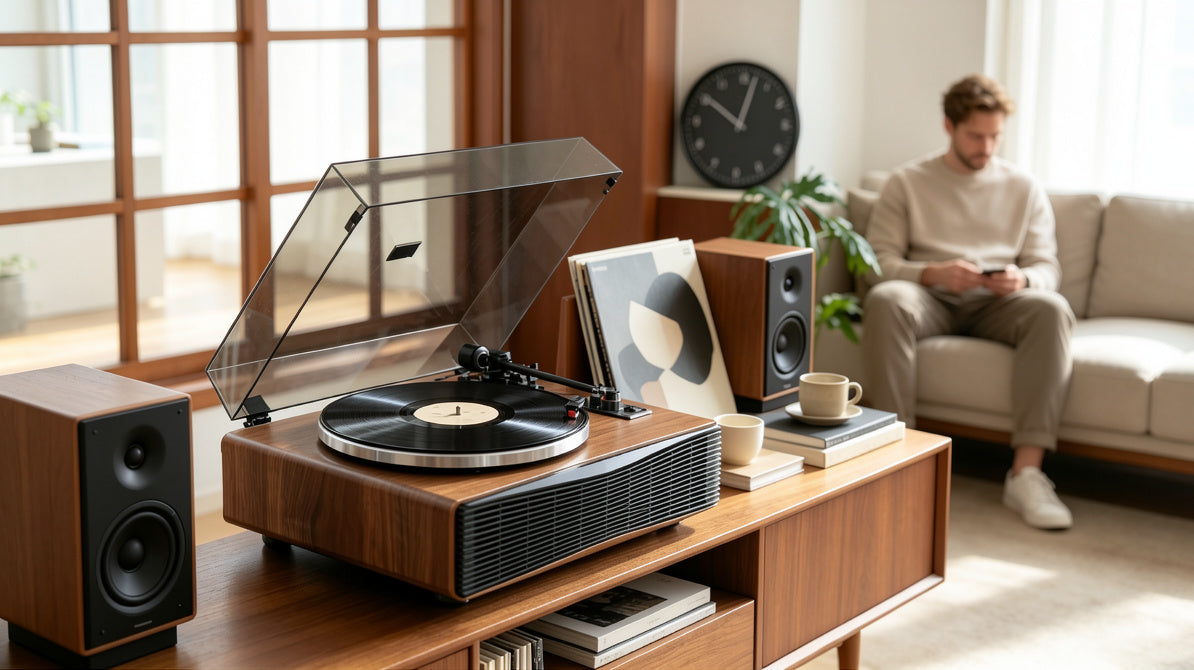
AUDURA One combines a belt-drive turntable with dedicated external stereo speakers.
That makes it a practical option for someone who wants a complete home vinyl system while still having separate speakers rather than relying on speakers built into the turntable itself.
For a gift buyer, this can remove one of the biggest uncertainties in choosing a standalone turntable:
“What speakers am I supposed to buy with it?”
With the main components already designed as a system, the gift is easier to plan and easier for the recipient to set up.
It can be a strong choice for someone who:
-
Does not already own a complete audio system
-
Wants a dedicated place for vinyl listening
-
Prefers separate speakers
-
Wants a complete gift rather than a single component
-
Wants more of a traditional home audio setup without sourcing every component individually
If you want to give a complete vinyl system without building the system piece by piece, AUDURA One is the straightforward choice.
AUDURA Core: For the More Enthusiastic Listener
Best for: experienced vinyl listeners, design-conscious enthusiasts, and people who want more control and flexibility from their turntable.
AUDURA Core takes a more advanced approach.
Depending on the current configuration, its feature set includes:
-
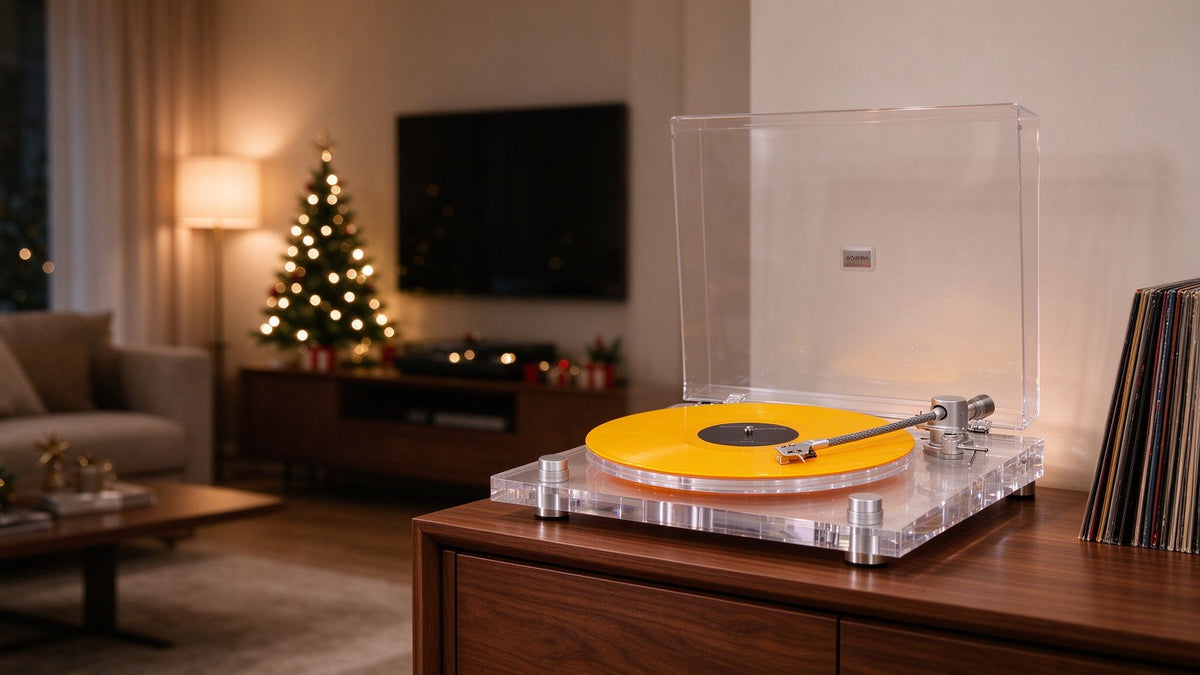
Transparent acrylic construction
-
Carbon fiber tonearm
-
Adjustable counterweight
-
Bluetooth 5.3
-
USB vinyl recording
-
RCA output
-
Optical output
-
Adjustable pitch
-
Belt-drive playback
These features make Core better suited to someone who already knows they want to explore vinyl beyond a simple first setup.
It can be a particularly interesting choice for someone who cares about both the visual presence of the turntable and the ability to fine-tune or expand their listening setup over time.
However, more features do not automatically make it the better Christmas gift.
If the recipient simply wants to play records without thinking about equipment, Play or One may be a better fit.
If they enjoy experimenting with their system, care about design, or want more flexibility for future listening, Core becomes much more relevant.
Core is for the listener who wants more from the turntable—not simply more features on the specification sheet.
Which AUDURA Turntable Fits the Recipient?
| Recipient | Best Starting Point | Why |
|---|---|---|
| First-time vinyl listener | AUDURA Play | Simple, self-contained listening |
| Small apartment or bedroom | AUDURA Play | Fewer separate components |
| Already owns compatible speakers | AUDURA Pure | Dedicated standalone turntable |
| Wants a complete home system | AUDURA One | Turntable and dedicated speakers together |
| Experienced vinyl listener | AUDURA Core | More control and flexibility |
| Design-conscious listener | AUDURA Core | Strong visual presence with a more advanced feature set |
The important thing is not to choose the most expensive AUDURA turntable.
Choose the one that makes the most sense for the person receiving it.
The right gift is the one they can connect, understand, enjoy, and keep using long after Christmas morning.
17. What NOT to Do When Buying a Turntable as a Gift
Sometimes the easiest way to make a good decision is to know which mistakes to avoid.
Buying a turntable as a gift does not have to be complicated. But a few common assumptions can turn a thoughtful present into a system the recipient cannot easily use.
Don't Buy the Most Expensive Model Just Because It's a Gift
More expensive does not automatically mean better for that particular person.
A high-end turntable is not necessarily a better gift if the recipient lives in a small apartment, already has a simple audio setup, or simply wants an easy way to play a few favorite records.
Instead of asking:
“What is the most expensive turntable I can afford?”
Ask:
“What is the most appropriate turntable for this person?”
A well-matched system is usually a better gift than an unnecessarily complicated one.
Don't Assume They Have Speakers
Always check.
This is one of the most common practical mistakes when buying a standalone turntable for someone else.
If the recipient does not already have compatible speakers, an amplifier, or another suitable audio system, a standalone turntable may not be enough to start listening.
Before you buy, make sure you understand the complete setup—or choose a system that already includes the essential components.
Don't Assume Bluetooth Is Necessary
Bluetooth can be useful, but it is not automatically a sign of a better turntable.
It matters when it solves a real problem.
If the recipient already uses Bluetooth speakers or headphones, wireless connectivity may make the setup more convenient.
If they already have a wired stereo system they enjoy, Bluetooth may be much less important.
Choose connectivity based on how the recipient actually listens—not simply because it appears on the specification sheet.
Don't Buy Based Only on Looks
Design matters.
A turntable is often visible in the home, so appearance can absolutely be part of the decision.
But it should not replace the practical questions.
Before buying, also consider:
-
Cartridge and stylus
-
Speaker requirements
-
Phono-stage configuration
-
Connectivity
-
Setup requirements
-
Replaceable stylus
-
Compatibility with the recipient's existing system
A beautiful turntable that cannot integrate with the recipient's equipment is still the wrong gift.
Don't Overcomplicate the First Setup
A beginner does not need to understand every detail of hi-fi before listening to their first record.
If the setup requires too many separate components, unfamiliar connections, or complicated adjustments, the excitement of receiving a turntable can quickly turn into frustration.
That does not mean beginners should never have an upgradeable or more advanced system.
It simply means the level of complexity should match the person receiving it.
A good Christmas gift should make the first listening experience feel exciting—not intimidating.
Don't Ignore Future Maintenance
A turntable is not completely maintenance-free.
Before buying, look for practical information about:
-
Stylus replacement
-
Basic setup
-
Record and stylus care
-
Available accessories or replacement parts
-
Warranty and customer support
A replaceable stylus is particularly useful for someone who plans to listen regularly.
The goal is not to predict every future upgrade.
It is to make sure the turntable still makes sense after the excitement of Christmas morning has passed.
Choose something the recipient can enjoy now and continue using comfortably over time.
18. The Best Christmas Turntable Gift Is the One They Will Actually Use
There is a temptation to think about vinyl in terms of equipment.
Turntable.
Cartridge.
Stylus.
Speakers.
Phono stage.
Cables.
All of these things matter.
But the reason people enjoy vinyl is rarely because they want to own a collection of audio components.
They enjoy the experience.
They like pulling an album from the shelf.
They like looking at the artwork.
They like placing the record on the platter and lowering the stylus.
They like having a physical object connected to the music.
They may enjoy listening to an entire album, taking a break from streaming, or simply creating a more intentional listening ritual.
And sometimes, they simply like the way a turntable looks in their home.
That is why convenience matters.
If a turntable is too complicated to use, it may sit untouched.
If the speakers are difficult to connect, the first listening session may never happen.
If the system takes up too much space, it may never find a permanent place in the home.
If the recipient cannot understand how the components fit together, the excitement of receiving a turntable can quickly become frustration.
The best gift removes those barriers.
It gives the recipient a system that fits their space, their equipment, their listening habits, and their level of experience.
Because ultimately, the best Christmas turntable is not the one with the longest specification list.
It is the one they will actually use.
Frequently Asked Questions
1. Is a turntable a good Christmas gift?
Yes, especially if the recipient already owns vinyl records or has expressed interest in collecting or listening to vinyl.
Before buying, find out whether they already have speakers or another compatible audio system. A standalone turntable may require additional equipment, while an all-in-one or complete system can make the gift much simpler.
The best turntable gift is one that matches the recipient's existing setup and listening habits.
2. Do I need to buy speakers with a turntable?
It depends on the turntable and the recipient's existing audio equipment.
A standalone turntable may need powered speakers, an amplifier and passive speakers, or a compatible audio system. An all-in-one record player may already include built-in speakers, while some turntables can connect to compatible Bluetooth speakers or headphones.
Before buying, check exactly how the turntable is designed to connect to the rest of the system.
3. What is the best turntable to buy as a gift for a beginner?
There is no single best turntable for every beginner.
The right choice depends on whether the recipient already has speakers, how much space they have, their budget, and whether they prefer an all-in-one system or a standalone turntable.
For a beginner, prioritize:
-
Simple setup
-
Reliable everyday playback
-
A replaceable stylus
-
Compatible connections
-
A sensible overall system
-
Features that fit the way they actually listen
The goal is to make the first experience with vinyl enjoyable rather than unnecessarily complicated.
4. Should I buy a turntable with Bluetooth?
Bluetooth can be useful if the recipient already owns compatible Bluetooth speakers or headphones, or if they want a more flexible wireless setup.
It is not essential for enjoying vinyl, however.
Before buying, check what the Bluetooth function actually does. Some products support Bluetooth output for sending vinyl audio to compatible wireless devices, while others may support Bluetooth input for playing audio from another device.
If the recipient already has a traditional wired stereo system, a wired connection may be the more natural choice.
5. What is the difference between a turntable and a record player?
A turntable generally refers to the vinyl playback component of a larger audio system.
A record player often refers to a more self-contained product that may include amplification and built-in speakers.
The terms are frequently used interchangeably in everyday conversation, so the most important thing when shopping is to check exactly what the product includes.
6. How much should I spend on a turntable as a Christmas gift?
Your budget should depend on the complete listening system, not just the price of the turntable.
A standalone turntable may require additional speakers or other equipment, while an integrated or all-in-one system may include more of what the recipient needs.
For many first-time listeners, it is more useful to choose a reliable, compatible system that fits the budget than to spend as much as possible on the turntable itself.
Focus on:
-
System compatibility
-
Setup simplicity
-
Reliable playback
-
Replaceable stylus
-
Long-term usability
The best gift is not necessarily the most expensive one. It is the one that gives the recipient a complete and enjoyable listening experience.
7. Are cheap record players bad for vinyl?
Not automatically.
Affordable record players vary considerably in design and quality. Some inexpensive models may make compromises in areas such as build quality, cartridge and stylus design, tonearm construction, speakers, or long-term serviceability.
Instead of judging a product solely by its price, look at the actual components, setup requirements, and whether the product is appropriate for the way the recipient plans to listen.
A beginner does not need an expensive audiophile system. But choosing a well-designed product with sensible fundamentals can help create a better starting point.
8. Should I buy a vinyl record with the turntable?
If you know the recipient's musical taste, adding a favorite album can make the gift more personal.
If you know a specific record they already love, that is usually a safer choice than guessing what they might enjoy.
If you do not know their taste, consider a record-store gift card instead.
You can also keep the gift simple. A well-chosen turntable and one meaningful record can be more memorable than a large bundle of accessories.
9. Can I Give Someone a Turntable If I Don't Know What Audio Equipment They Have?
Yes, but you should be careful about choosing a standalone turntable without knowing what it needs to connect to.
If you cannot check the recipient's existing audio setup, a more self-contained system may reduce the risk of missing speakers, amplification, or other essential equipment.
Another option is to give a turntable that supports a connection method you already know the recipient uses, such as compatible Bluetooth audio.
If you are unsure, choose the system that minimizes the number of unknowns.
That is usually safer than choosing a turntable based only on its appearance or specifications.

Conclusion
Buying a turntable as a Christmas gift does not have to be complicated.
You do not need to become an audio engineer or memorize every specification.
Start with the person.
Find out what they already own.
Think about their space.
Consider how they actually listen to music.
Decide whether they need an all-in-one system or a standalone turntable.
Make sure the complete setup can actually work together.
And most importantly, choose something that makes them want to listen.
For some people, that may be a simple all-in-one record player.
For others, it may be a dedicated turntable that becomes the foundation of a growing vinyl system.
There is no single correct way to enjoy records.
At AUDURA, we believe modern vinyl should fit naturally into everyday life: thoughtfully designed, easy to understand, simple to set up, and enjoyable to live with.
Whether you are buying someone's first turntable or helping a longtime vinyl listener refresh their listening space, the best Christmas gift is not necessarily the most expensive one.
It is the one that gets used.
The one that gets a record spinning on Christmas morning.
And hopefully, the one that becomes part of many listening moments long after the decorations come down.
Not sure which AUDURA turntable fits the recipient? Explore the AUDURA turntable collection.